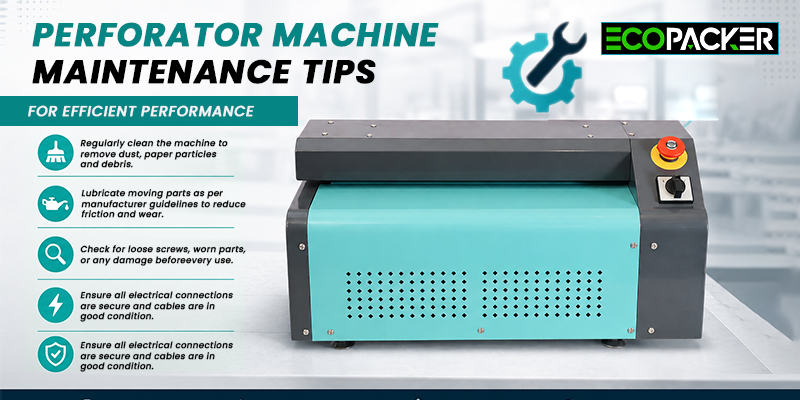
A cardboard perforator machine is one of the essential devices used in a packing or box manufacturing unit. The machine forms accurate lines of perforations in cardboard and corrugated sheets so that they can be folded, torn, or separated easily. No matter whether you have a small packing unit or a large manufacturing plant, your perforator machine operates constantly round the clock. Just like other mechanical machines, this device too requires regular maintenance to function effectively. If it does not get the proper maintenance, the machine may face problems of blade wear, misalignment, motor failure, etc., which decrease efficiency and lower the quality of your cardboard boxes. In this blog post, we will discuss some basic, practical, and effective maintenance techniques for your machine.
Key Features of a Good Perforator Machine
It will be easier to understand maintenance once one understands the features that make a perforating machine reliable and easy to maintain. Some of the features include:
- Sturdy build quality –This helps reduce the vibration effect, which enhances accuracy of the perforation lines.
- Sharp, replaceable blades – Good quality blades give clean perforation cuts and are easy to change when worn out.
- Adjustable perforation settings – Ability to change the depth, spacing, and pattern of perforation for different cardboard thicknesses.
- Smooth feed and roller system – Ensures the cardboard sheet moves evenly without jamming.
- Safety guards and switches – Protects operators from moving blades and rollers during operation.
- Digital or manual controls – Either digital or manual control makes it easier to set speed and perforation depth.
- Low noise motor – Motor is balanced which means that the motor will be quiet and safe to use.
All these features not only help in improving the quality of output but also simplify the process of maintenance.
Daily Cleaning of the Machine
Dust, cardboard particles, and small paper pieces will collect rapidly on the blades, rollers, and feeding table of the cardboard perforator. In case the dust is not removed on a daily basis, it may cause a blockage in the machine, affecting its cutting accuracy. Clean up the dust with the help of a brush or air blower on an hourly basis. Never use water for cleaning electrical components of the machine.
Blade Inspection and Sharpening
Blades are the most crucial component of a perforating machine. Due to their constant use over a particular duration of time, there are chances that the blades become blunt and torn, causing low-quality perforations. The blades should be checked on a weekly basis to see if there are any signs of wear and tear like corrosion, chipping, and bluntness. The blades may be either replaced or honed accordingly.
Lubrication of Moving Parts
Rollers, gears, bearings, and sliding rods need proper lubrication to move easily without any friction. Proper lubrication of the machinery parts makes sure that there is no noise made by the machine and that its parts are not worn out prematurely due to insufficient lubrication. This is achieved by using the appropriate lubricant or grease for the prescribed period of time ranging between one and two weeks. However, excess lubrication needs to be avoided since it attracts dust.
Checking the Electrical System
Poorly wired systems, faulty switches, or even an insufficient power supply can result in abrupt interruptions and fluctuations in the perforation rate. It is necessary to conduct regular inspections of the control panel, motor wiring, and safety switches for any apparent damage. In case you find flashing lights or strange noises coming from the motor, along with a slow reaction from the control panel, you should have it checked right away.
Belt, Roller, and Alignment Checks
The belts and rollers assist in feeding the sheet of card properly within the machine. However, in some cases, belts may become slack and worn out due to wear and tear with time, leading to misalignment of the sheet during the perforation process. It is important to check for belt tension every month and replace any belt which is cracked and frayed.
Calibration and Test Runs
It is always advisable to conduct a test printing after each repair, replacement of the blades, or prolonged non-use. Such an action will help one ensure that the calibration for the depth of penetration, spacing between the holes, and the actual pattern are well set. Calibration mistakes might cost one the extra cardboard paper.
Proper Storage and Environment
Your machine’s surroundings play an important role as well in how it functions. Make sure you keep your machine in a place where there is no moisture since moisture leads to rusting of the blade. It’s important that you cover your machine if it is not going to be used for a long time.
Operator Training and Safe Handling
Many of the maintenance problems arise simply due to the lack of proper training in the operators. Make sure that your workers know the right way to load sheets of cardboards, how to set the perforation depths according to the material used and how to detect the early signs of trouble such as strange sounds and vibrations.
Differences: Manual vs Semi-Automatic vs Automatic Machines
Different machines have different maintenance requirements. In a manual cardboard perforator machine, the blade would require frequent checking because the operation is done manually and the pressure and speed are controlled by the person doing the job and not by the machine itself. A semi-automatic machine is less laborious than the manual one, but still requires occasional calibration checking. This is because adjustments are made in between batch productions. The fully automatic perforator machine, however, would need more electric and software checking than blade checking due to its dependence on electronic components.
Conclusion
Taking care of your machine is not a difficult task, but requires a little discipline on your part. Such simple practices as cleaning the machine daily, sharpening its blades, lubricating the parts properly, and periodically checking the calibration can help increase the lifespan of your perforator machine and ensure smooth operation of your production line. This way, you save yourself time, money, and effort while maintaining the high quality of each cardboard box produced by your machine.
For more informative guides on packaging machinery and cardboard processing, you can explore resources at ecopacker.co.in.
Frequently Asked Questions
1. How often should I clean my perforator machine?
It is preferable to clean the machine on a daily basis, after every shift to ensure that no dirt or cardboard remains stuck to the machine. This will keep the accumulation of dirt around the blades and rollers away, thus ensuring that there are no errors in cutting.
2. What are the signs that blades need replacement?
Irregular edges rather than perfect perforations, more noise while the paper cutter is operating, as well as chips and rust on the blades themselves, are typical symptoms. Should the cutter machine appear to be having difficulty or the paper is being torn, it is time to look into replacing the blades.
3. Can I lubricate the machine myself?
Certainly, when it comes to lubrication of the rollers, gears, and bearings, one can always undertake the process easily with the assistance of some professional manpower, using the right lubricating oil. However, one should bear in mind that one should not over-lubricate the equipment as excess grease tends to attract dust.
4. Why does my machine produce uneven perforation lines?
This condition is normally brought about by rollers not being in alignment, bad belts or dull blades. Uneven punching may also be brought about by miscalibration after changing of the blade. Running a test sheet and checking for alignment will help determine the problem.
5. How long does a perforator machine typically last with good maintenance?
A well-made perforator machine is capable of lasting for many years with the right cleaning, blade replacement, lubrication, and storage procedures. The duration of life will depend on usage time, material type, and the extent to which the maintenance program is observed.
Eco-Friendly Packaging
Interested in the Eco-Packer Machine?
Fill out our inquiry form and our team will get back to you within 24 hours.
