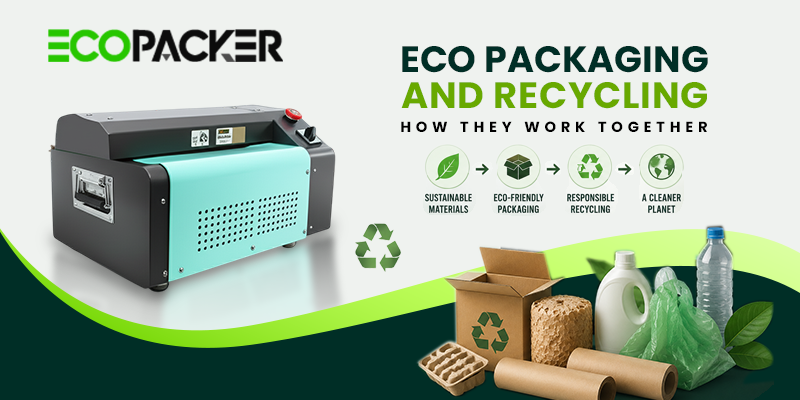
Packaging is always necessary for the protection, preservation, and proper transportation of products. But the development of industries and shopping online has brought along with it many environmental concerns related to the packaging of products. This is due to the fact that the packaging industry has been generating much wastage, which ends up being disposed of in landfills, thereby polluting our environment. With rising concerns regarding sustainability, there is a need for a solution in the form of sustainable packaging.
Eco-packaging is another example of an innovative solution, which has been gaining a lot of attention. Utilizing eco packaging makes it possible for the company not only to meet the demands of the customers but also to protect the environment from being affected negatively. Moreover, the combination of eco-packaging with recycling will result in resource conservation and lower carbon footprint.
Understanding Eco Packaging and Recycling
Unlike traditional packaging that has the sole purpose of safeguarding goods, contemporary packaging is made not only with this in mind but is also environmentally friendly. This is where Eco Packaging becomes relevant as it is created from substances and through production processes that will help reduce waste, preserve natural resources, and facilitate disposal. Many companies have decided to use lighter and more environmentally friendly packaging that will do the same job but produce less harm.
In turn, recycling supports this process because the old packaging can be transformed back into material needed to create other products. In this way, it becomes possible to avoid using natural resources each time when new packaging has to be created.
Key Features
- Reduces packaging waste at the source.
- Conserves natural resources.
- Supports responsible material use.
- Lowers environmental pollution.
- Promotes efficient waste management.
- Encourages a circular economy.
How Packaging and Recycling Support Each Other
Packaging and recycling go hand in hand. The value of recycling increases considerably if the package used makes it easy to separate and recycle the contents. Companies now take into account the lifecycle of the product packaging during its development phase to make sure that recycling is an efficient process.
The Eco Packaging helps this effort by using minimal mixed content that usually hampers the recycling process. Materials such as paper, cardboard, glass, and aluminum are easier to recycle compared to packages that contain a mix of plastic and many other materials. The materials are then processed and turned into other products.
The partnership between responsible packaging and recycling creates several environmental benefits.
Benefits of Working Together
- Reduces landfill waste.
- Saves energy during manufacturing.
- Lowers carbon emissions.
- Conserves forests and natural resources.
- Reduces environmental pollution.
- Supports long-term sustainability goals.
A strong recycling system also encourages businesses to invest in packaging that can be recovered and reused, creating long-term environmental and economic benefits.
The Importance of Sustainable Packaging
These days, organizations have to maintain a fine line between protecting their products and caring about the environment. The concept of Sustainable Packaging helps to achieve the same by adopting an overall strategy for packaging material starting from its source to its disposal.
The adoption of sustainable packaging offers several advantages both to the environment and to the business. Light weight reduces transportation costs, efficiency saves resources from being wasted, and recyclable materials comply with environmental norms. There is also the added advantage of building consumer trust in the company.
Why It Matters
- Uses resources more efficiently.
- Reduces manufacturing waste.
- Improves brand reputation.
- Supports environmental compliance.
- Meets changing customer expectations.
- Encourages responsible production.
The Rise of Plastic-Free Alternatives
Plastic pollution has become one of the largest issues in terms of environmental issues all around the world. The single-use plastic packaging remains in the environment for several decades causing damage to nature and wildlife. Therefore, companies have started using the Plastic Free Packaging for those products which do not need to be protected by the usual plastic packaging.
Paper, molded fiber, bamboo, and agricultural residue can be used as alternative materials for many packaging processes since they can be recycled or decayed naturally under certain conditions.
Despite the fact that it is impossible to get rid of plastic packaging in some industries, the development of Plastic Free Packaging shows that innovation has made this task much easier.
Benefits
- Reduces plastic waste.
- Supports renewable materials.
- Minimizes environmental pollution.
- Encourages responsible consumption.
- Improves recycling opportunities.
- Protects natural ecosystems.
How Eco Friendly Packaging Improves Recycling
Easily recyclable packaging is essential for efficient waste management. The idea behind Eco Friendly Packaging is to make recycling easy with the help of using less material and preventing complicated combinations of elements which are difficult to separate. Easy to recycle packaging with the use of material such as paper, cardboard, and other materials which are recyclable will ensure that the material is easily collected and recycled.
There has been a trend among manufacturers to redesign their packaging by reducing unnecessary layers and using water based ink and adhesives which do not interfere with recycling.
Best Practices for Better Recycling
- Use simple packaging designs.
- Avoid unnecessary plastic coatings.
- Include clear recycling instructions.
- Reduce excess packaging materials.
- Choose recyclable inks and adhesives.
- Encourage consumers to recycle correctly.
By adopting Eco Friendly Packaging, businesses support recycling systems while reducing their overall environmental impact.
The Value of Recyclable Packaging in a Circular Economy
Circular Economy refers to keeping the materials in use for as long as possible, rather than following the conventional economic system that includes “make-use-dispose”. Recyclable Packaging plays a critical role in this economic system in that it facilitates the collection, processing, and transformation of materials into new packaging materials.
Paper, cardboard, glass, aluminum, and some recyclable plastics can be accepted in recycling centers and used many times. The use of such materials avoids the usage of new raw materials, conserves energy, and decreases greenhouse gases.
Common Recyclable Materials
- Paper and cardboard
- Glass containers
- Aluminum cans
- Steel packaging
- Corrugated boxes
- Selected recyclable plastics
Using Recyclable Packaging also helps businesses meet sustainability goals while giving consumers an easy way to dispose of packaging responsibly.
Benefits, Challenges, and the Future of Packaging
The union of responsible packaging and recycling provides numerous advantages both for business and customers and the environment in general. Businesses can benefit through avoiding wastage of materials, increased efficiency of operations, improved company image and compliance with new environmental standards. Consumers will have an opportunity to help the planet by choosing environmentally friendly businesses and recycling packaging responsibly.
However, there are some problems related to the process. Different recycling programs exist in different regions, and most of the consumers lack knowledge on how to dispose of some types of packaging. Also, the diversity of materials used in packaging and their contamination can decrease the effectiveness of recycling.
But at the same time, the outlooks on the future of the process look promising. Innovations continue to create better packaging options, better ways to recycle it and use renewable materials. Digital tags, lighter packaging and recycling technologies can help business to reduce the material losses, and consumers to recycle packaging more efficiently.
Conclusion
Eco-packaging and recycling are interconnected and help create an efficient system to resolve the problem of packaging pollution and conserve natural resources. Efficient packaging ensures that recycling is easy whereas efficient recycling ensures that important resources stay within the cycle and do not end up in the landfill. The above combination will be beneficial for companies as well as the environment.
Clean Planet Earth requires efforts on the part of producers, governments, and consumers. These goals can be achieved through proper packaging, recycling, and smart purchases.
FAQs
1. What is Eco Packaging?
Eco Packaging is the type of packaging that minimizes its impact on the environment through the use of sustainable materials and the promotion of recycling.
2. Why is Recycling Important to Packaging?
Recycling decreases the amount of waste disposed of at landfills, conserves natural resources, reduces the use of energy, lowers the emission of carbon dioxide, and makes recyclable material available for manufacturing packaging
3. What is the benefit of using Plastic Free Packaging?
Plastic Free Packaging helps reduce plastic pollution, supports renewable materials, improves recycling opportunities, and decreases the environmental impact of packaging waste.
4. Which materials are commonly used in Recyclable Packaging?
Materials such as paper, cardboard, glass, aluminum, steel, and plastics that are able to be recycled are normally used to make recyclable packaging.
5. How can businesses improve their packaging sustainability?
Businesses can reduce unnecessary packaging, use environmentally friendly materials for packaging, develop more environmentally friendly packaging systems, and introduce new packaging technologies.
Eco-Friendly Packaging
Interested in the Eco-Packer Machine?
Fill out our inquiry form and our team will get back to you within 24 hours.
