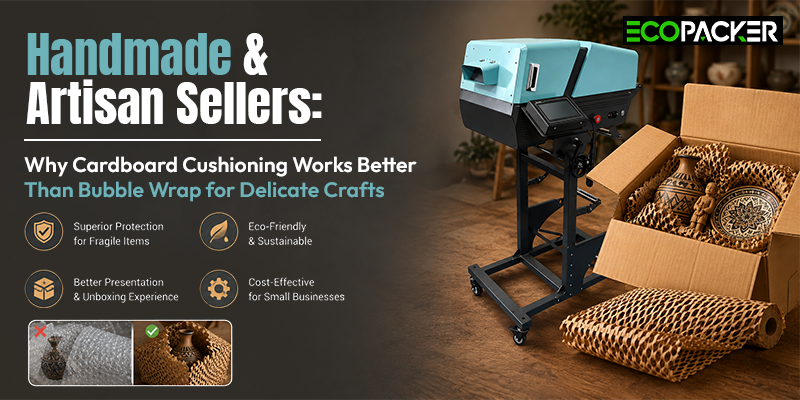
When marketing items like pottery, hand-made glass objects, jewelry, candles or other breakable items, you have no doubt felt that feeling of fear as you shipped your items out to a customer. But what if it breaks? Bubble Wrap has been the answer for a long time, but an increasing number of crafters are using paper packing material. Once you know why, you’ll never go back.
This article looks at the real differences between cardboard-based paper cushioning and plastic bubble wrap, and explains why so many small businesses are now packing orders with a paper cushion machine instead of rolls of plastic.
The Problem With Bubble Wrap for Handmade Items
Bubble wrap has long been the obvious choice of packing material simply due to its familiarity and availability. However, for artisan goods, there are a couple of disadvantages to using bubble wrap.
It shifts inside the box. Bubble wrap is also slick. It becomes easy for the bubble wrap to move away from the delicate object it was protecting at the very moment the object needed protection because the box will get jostled around during shipping.
It doesn’t mold to irregular shapes. Manually crafted items never have neat rectangular edges. It can be something like a handmade mug, a woodcarving, or even an ornament made from glass. Bubble wrap encircles them rather than following their contours, leaving spaces between them.
It’s not eco-friendly. Bubble Wrap is primarily manufactured using low-density polyethylene, which is a plastic material that cannot be recycled through most curb-side programs. Customers have become increasingly environmentally conscious, and wrapping products in plastic has become detrimental to brand image.
Storage takes up space. Bubble wrap rolls are very cumbersome to store, and that presents a significant problem to those who operate from their homes and studios with limited storage space.
What Makes Paper Cushioning Different
The paper cushion, which is made of recycled kraft paper, operates on an entirely different basis. While the plastic bubble cushion utilizes trapped air bubbles to create the cushion effect, the paper cushion creates a cushion through crumpled paper, folding paper, or forming the paper into a honeycomb pattern.
The cushion is always made to order using the paper cushion machine that processes flat rolls of kraft paper in a way that creates a cushion by crumpling or folding the paper. The cushion created can be adjusted to suit the protection level required for the item.
Since the paper naturally conforms to the shape of anything it is wrapped around, it offers a firm grip on the shape as opposed to the flat plastic cushion.
Why Paper Cushioning Protects Delicate Crafts Better
1. It Conforms to Odd Shapes
Handmade products are hardly ever uniform. The paper cushion machine makes cushioning that is designed to fold up into pockets naturally, making it cover any rough areas such as handles and spouts rather than leaving behind spaces like bubble wrap does.
2. It Has Better Shock Absorption for Static Loads
Bubble wrap acts primarily against puncture resistance due to air encapsulation. However, paper cushioning, particularly honeycomb and crumpling kinds, spreads the force of impact across a larger area. In case of ceramics, glass, and resin arts, this distribution minimizes the risk of formation of hairline cracks due to an impact.
3. It Stays Put Inside the Box
Paper possesses inherent texture and frictional properties. When wrapped around a commodity, paper has the tendency of staying in the same position that you have arranged it in despite a box being dropped, jolted, or stacked below other heavy boxes.
4. It’s Naturally Breathable
Some handcrafted products, such as those made from natural wood, dried flowers, or specific types of resin products, can be delicate to moisture that is stored. The plastic bubble wrap will hold moisture within the container, whereas the paper packing will help protect against moisture problems due to its breathing capability.
Sustainability: A Growing Reason to Switch
These days, consumers, particularly those buying products from individual craftsmen, care about the origin of the purchase and its packaging. Recycled paper bubble wraps are biodegradable and recyclable using conventional paper recycling processes. Moreover, such wraps are made from post-consumer material.
Choosing paper cushioning rather than plastic gives you the message that your brand cares not only about profit but also about its impact on the planet. Handmade items are made by people who have put a lot of love into making them, so it’s important that there is consistency between the product and its packaging.
How a Paper Cushion Machine Fits Into a Small Shipping Operation
People have a mistaken idea about paper cushioning machines in that these machines can only be used in big warehouses. However, it should be noted that there are small models of a paper cushion machine designed for use in small studios, individual traders, and budding craft businesses.
Here’s generally how the process works:
- Flat rolls of kraft paper are loaded into the machine.
- The machine feeds, crumples, or folds the paper into a cushioned, three-dimensional form.
- The cushioning comes out ready to use, either as loose fill, wrap-style sheets, or honeycomb padding, depending on the machine type.
- Sellers cut the output to size and pack it directly around the item or use it to fill empty space in the box.
The reason for this is that since the paper comes off the rolls freshly and not already formed into bubble wrap rolls, the sellers can create the required cushioning as per the need for each order. There is less wastage than when one cuts portions from bubble wrap rolls.
Cost and Efficiency Considerations
Paper padding typically needs less storage space compared to bulkier bubble wrap rolls because flat kraft paper rolls have a lot smaller space requirement compared to bubble wrap rolls with the same lengths. In the long run, most sellers will also find that using paper reduces wastage since the machine cuts the exact amount of paper needed for each item.
The labor required is similar, and sometimes even quicker since wrapping an item after inserting it into the machine takes a bit of extra work but not as much as the process of tearing and cutting bubble wraps.
Choosing the Right Type of Paper Cushioning for Your Crafts
Not all paper cushioning looks the same, and different formats suit different products.
- Crumpled kraft paper works well as loose void fill around small, lightweight items like jewelry or small ornaments.
- Honeycomb paper wrap is ideal for wrapping individual fragile pieces like mugs, vases, or picture frames, since its cell structure offers cushioning on all sides.
- Folded pad-style paper works well as a base layer at the bottom and top of a box, adding an extra buffer beneath more delicate wrapped items.
Many artisan sellers use a combination: honeycomb wrap directly around the item, with crumpled paper filling any remaining gaps in the box.
Making the Switch: What to Expect
However, the transition from bubble wrap to other packing materials takes time, but the process is easier for sellers to go through than they think. The first step to take is to try packing your more delicate products in paper cushioning and see how they arrive. It seems that a lot of sellers who sell handmade products claim that their items get damaged less often because of the fact that paper does not slip around like plastic film does.
In a couple of packaging sessions, most sellers become able to figure out how much paper cushioning the particular item needs, just as they once did with bubble wrap.
Conclusion
Handmade sellers have packaging as an aspect of their products rather than simply packaging. The paper cushion, which is made by a paper cushion machine, is more conformable to protect, is likely to reduce the chances of any shifting while in transit, helps you achieve your sustainability objective, and is cheaper to store than bubble wrapping in rolls. If you sell fragile items like ceramics, glasses, wooden, or resin crafts, then adopting the use of paper cushioning is no longer a packaging fad but actually protecting the fragile craft.
For handmade sellers, choosing the right packaging can make a real difference in protecting products and reducing packaging waste. With reliable paper cushioning solutions from Ecopacker, you can protect fragile crafts while creating a more sustainable and efficient packaging process.
Frequently Asked Questions
1. Is paper cushioning as protective as bubble wrap for fragile items?
Yes, in many cases paper cushioning offers better protection for irregularly shaped items because it molds around curves and handles instead of sitting flat. Honeycomb and crumpled paper distribute impact across a wider area, which helps reduce breakage in ceramics, glass, and resin crafts during shipping and handling.
2. Can a small home-based craft business afford this kind of paper cushioning equipment?
Yes, compact desktop-style machines are designed specifically for small studios and home-based sellers. They take up limited counter space, use standard kraft paper rolls, and let sellers produce cushioning on demand, which often works out more efficient than buying and storing large bubble wrap rolls.
3. Does paper cushioning work for very small items like earrings or rings?
Yes, crumpled kraft paper works well as a soft void fill around small, lightweight jewelry pieces. It keeps items from moving inside a box or padded envelope, and it can be layered thicker for extra protection around delicate clasps, chains, or stones.
4. Is paper cushioning recyclable and better for the environment than bubble wrap?
Generally, yes. Paper cushioning is typically made from recycled kraft paper and can go into standard paper recycling streams, unlike most plastic bubble wrap, which usually requires special drop-off recycling. This makes it a more sustainable packaging choice for eco-conscious handmade sellers.
5. How much paper cushioning material is needed per package compared to bubble wrap?
It varies by item size and fragility, but many sellers find that a paper cushion machine reduces waste since it produces cushioning on demand for the exact size needed. This is different from bubble wrap, where sellers often cut and discard excess material from a roll.
Eco-Friendly Packaging
Interested in the Eco-Packer Machine?
Fill out our inquiry form and our team will get back to you within 24 hours.
