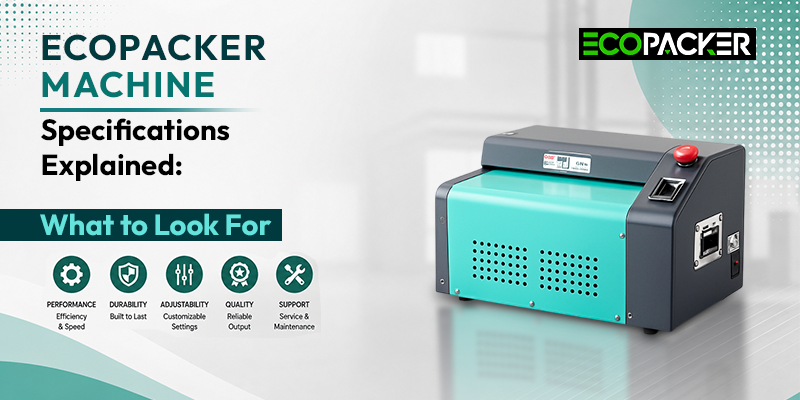
With such a wide selection of packaging equipment available and different technical specifications and capabilities that come with each, the process of choosing can seem daunting. If the goal of your company is to go eco-friendly, an ecopacker machine will usually be among the first purchases that you want to consider. The ecopacker machines help you save on materials, decrease plastic usage, and promote Eco Packaging concepts without compromising production or labor. However, all machines are different, and when buying for the first time, it is hard to imagine how significant are the differences between them, and what are the specifications that matter the most. In this blog, I share with you some of the specifications to consider.
Why Machine Specifications Matter More Than You Think
Specifications are significant since they determine how the equipment functions on a daily basis after installation, rather than its image from a sales catalog. Numerous customers look at the price only and neglect other factors, which are among the leading causes of buyer’s remorse, especially when the machine fails to cope with the order volume. Operating speed shows the ability of the equipment to handle the number of orders per day, material compatibility indicates the possibility of processing of films, paper, and pouches necessary for your products, and power consumption determines the costs of electricity for the next several years of operation. Footprint of the equipment matters because it determines how much place the machine will occupy on your current floor. The automation level is no less important, as semiautomatic machines require more employees than the fully automatic ones. Warranty period and availability of spare parts complete the list since even the best equipment will need maintenance some time in the future.
Core Specifications You Should Check Before Buying
This section covers the technical details on a typical spec sheet that buyers should prioritize before comparing brands or requesting quotes from multiple suppliers. This kind of equipment often comes with dense technical numbers, so a clear checklist
makes the process much easier and prevents costly guesswork:
- Sealing mechanism – heat, ultrasonic, or pressure sealing suit different materials.
- Output capacity – packages per hour, based on your business size.
- Material thickness range – handles both thin and thicker packaging.
- Noise levels – important for indoor facility comfort and safety.
- Maintenance needs – easy part access and simple cleaning routines.
- Control panel – digital presets for switching product lines quickly.
- Safety features – emergency stops and guarded moving parts.
How Sustainable Packaging Equipment Supports Eco Goals
Today, sustainability is not just a desirable feature of any industry but rather a requirement of the majority of your partners, customers, and regulations. Your choice of equipment will determine whether you comply with your environmental goals in reality or not. With an adequately selected eco packaging machine, you will manage to cut down unnecessary material usage while ensuring that the item is protected within the transportation process. Moreover, thanks to the ability to work with recyclable or biodegradable material, your packaging process will become more efficient since the integrated sensors will help to prevent excessive film, paper, or cushioning usage. Efficient motors and optimal run cycles will contribute to lowering energy consumption and thereby help to minimize the carbon footprint of your plant. Many regions today demand documentation of your eco packaging solutions, and the majority of modern machines can perform this task automatically for you and save you numerous hours spent on filling out paperwork. Customers also tend to prefer environmentally-friendly companies, and therefore selecting appropriate packaging equipment will not only help you to be compliant with the regulations, but also improve the brand’s reputation.
Common Mistakes to Avoid When Choosing This Equipment
This section highlights the errors buyers repeat most often when comparing packaging machines, so you can avoid them from the very start of your search. Even experienced buyers overlook small details that turn into expensive problems within months of daily use. Watch out for these:
- Ignoring scalability – buying only for today’s volume forces early replacement.
- Overlooking after-sales support – warranty and technician response time matter.
- Chasing the lowest price – often means higher long-term repair costs.
- Skipping material testing – always test with your actual packaging materials.
- Ignoring certifications – check for recognized quality or environmental standards.
- Underestimating training time – operators need practice before full efficiency.
- Ignoring supplier reviews – past customer feedback reveals real-world reliability.
Tips for Comparing Different Machine Models
This section offers a practical checklist for evaluating multiple machines side by side instead of judging each one in isolation or trusting a single sales pitch. A consistent comparison method prevents you from being swayed by a single impressive feature while ignoring weaker points elsewhere. Use these tips:
- Request live demonstrations rather than relying on spec sheets alone.
- Ask about the average lifespan of key components.
- Confirm the equipment supports future upgrades as your Eco Packaging needs expand.
- Read verified reviews from businesses with similar production volumes.
- Compare total cost of ownership, not just the upfront price.
- Check delivery and installation timelines before committing.
- Involve your floor operators in the final decision, since they will run it daily.
Conclusion
However, the choice of packaging machinery goes beyond just looking at price tags and marketing slogans. Through careful study of criteria like sealing systems, production rate, materials, and power consumption, you will be able to find an eco-packer machine that not only helps you achieve efficiency but also is in line with the overall idea of Eco Packaging. Making no mistakes, choosing the best model and paying attention to after sales service are the factors that lead to the successful choice of machinery. In this case, your packaging machinery will not only become more efficient, but it will also become more environmentally-friendly.
Frequently Asked Questions
- 1. What is an ecopacker used for in daily production?
It packages products using sustainable, recyclable, or biodegradable materials, helping businesses cut plastic waste while keeping production speeds efficient and consistent throughout the day.
- 2. How do I know which eco packaging machine size is right for my business?
Consider your daily order volume, available floor space, and future growth plans. Suppliers can usually recommend suitable models once they understand these operational details.
- 3. Are eco packaging solutions more expensive than traditional packaging methods?
Initial costs can be slightly higher, but long-term savings on materials, compliance, and brand reputation often offset that difference within a reasonable period.
- 4. What maintenance does this type of equipment typically require?
Regular cleaning, sensor checks, and periodic replacement of sealing components keep the machine running efficiently and extend its overall service lifespan.
- 5. Can one ecopacker handle multiple types of packaging materials?
Many modern machines support various materials, but it’s important to confirm compatibility
Eco-Friendly Packaging
Interested in the Eco-Packer Machine?
Fill out our inquiry form and our team will get back to you within 24 hours.
