If your business packs, ships, or sells goods in cardboard boxes, you already know how important clean, easy-to-open packaging is. Many companies still rely on manual cutting or basic tools to score and perforate boxes. This works fine at a small scale. But as orders grow, this manual process becomes slow, inconsistent, and costly.
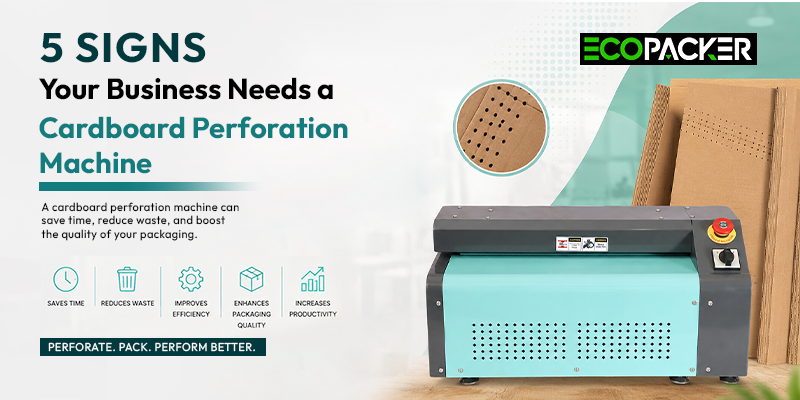
This is where a cardboard perforation machine comes in. It is designed to create clean, even perforation lines on cardboard sheets or boxes, making them easier to tear, open, or separate along a set line. Many industries, from food packaging to e-commerce shipping, use this equipment to speed up production and improve product presentation.
In this article, we will walk you through five clear signs that tell you it’s time to invest in this equipment, along with the real benefits it brings to your packaging process.
What Is a Cardboard Perforation Machine?
Perforating machine for packaging is an industrial machinery used for making controlled patterns of holes and small cuts into cardboard products. Perforating is different from cutting in that while cutting involves making a complete cut through the material, perforating involves making holes with small connection points such that the material remains in one piece until pressure is applied to tear it apart. Examples of items made through perforating include packaging of cereals, medicine, couriers, and coupon items.
This machinery is usually utilized together with die cutting or slitting machine in the production process of packaging.
Sign 1: Your Team Spends Too Much Time on Manual Cutting
If your staff is still using hand tools, blades, or basic scoring wheels to create tear lines on boxes, you are likely losing hours every day. Manual perforation is slow and depends heavily on the skill of the worker. Two workers can produce two different results, which affects the overall quality of your packaging.
A cardboard perforation machine removes this bottleneck. It creates consistent perforation lines at a much faster rate, freeing up your workers for other tasks and reducing the overall production time per batch.
Sign 2: You Are Seeing Inconsistent or Poor-Quality Perforations
Hand perforation usually results in non-uniformity. Some perforations are too deep and cause tearing of the box even before it gets delivered. Others are not deep enough and make it difficult for the end user to open the packing. This will definitely affect the image of your business because you are dealing with other companies through packaging.
With the help of a carton perforator, this issue is eliminated since there is uniformity in terms of the depth, distance and pressure. All the boxes produced are of high quality thus increasing your customers’ confidence.
Sign 3: Your Order Volume Has Increased
Growing is a great problem to have, but it poses challenges for inefficient processes. If your order quantity has increased and the process cannot cope with that, then this is a definite sign. Box perforating machine is designed for constant work with large quantities without compromising on the speed or quality of work.
Having this machine at an appropriate moment allows accepting bigger orders without refusing to cooperate due to inability to fulfill the order.
Sign 4: You Are Facing High Material Wastage
When perforation is done incorrectly by hand, boxes may tear apart during handling or fail quality checks. This leads to wasted cardboard, wasted printing costs, and extra labor to redo the batch. Over time, this waste adds up to a real financial loss.
An industrial perforation machine is engineered for precision. It applies the right amount of pressure at the right points, which significantly reduces damaged sheets and lowers your overall material cost per unit.
Sign 5: You Want to Offer Better Packaging Features
Consumers have become used to the idea of getting packaging that is practical and user-friendly. Tear strips, opening flaps, and perforations for resealing and coupons have all become a must-have requirement for packaging today. In order for you to supply such features to your customers, you should consider investing in machinery that can deliver on that promise.
This is where the cardboard perforation machine comes in. The machine will enable you to integrate practical features in your packaging, and that is how you can sell your product to potential clients.
Why Upgrading Makes Business Sense
Beyond fixing the problems above, adding this equipment to your production line offers a few broader advantages:
- Consistency at scale: Every piece of cardboard is perforated the same way, whether you are producing 100 units or 10,000 units.
- Lower long-term costs: Less material waste and less rework mean better margins over time.
- Faster turnaround: Orders move through production quicker, helping you meet tight delivery deadlines.
- Better client relationships: Reliable quality builds trust with businesses that depend on you for their packaging needs.
Conclusion
When your company struggles with delays caused by manual labor, inconsistency in quality, increased number of orders, high amount of wasted materials, or requests from your customers for enhanced packing options, this means it is time for your company to think of investing in cardboard perforation machines. It is not only about improving the speed of manufacturing, but also about creating a more professional, consistent and scalable manufacturing process of packaging. Prior to buying the machinery, it would be a good idea to assess the number of products that are manufactured in a day, the kind of cardboard used and the particular patterns requested by your customers. It will allow you to pick the machinery based on your real needs. If you’re looking for a trusted option in this space, Eco-Packer offers an eco-friendly cardboard perforation machine that turns waste cardboard into protective packaging material. It’s a solid choice for e-commerce and small businesses aiming to cut packaging costs while going green.
Frequently Asked Questions
1. What industries commonly use a cardboard perforation machine?
Such machines are commonly employed in food packing, medicine cartons, online shopping parcels, and even retail packages. Every company requiring tear strips, peel open tabs, or coupon sections in cardboard packages can make use of this machinery. Such machinery is highly beneficial for firms that have to produce cardboard packages in large numbers.
2. Is perforation different from die-cutting?
Yes. Die-cutting fully cuts through the cardboard to create a shape or opening, while perforation creates a line of small connected cuts that allow the material to tear along that line when pressure is applied. Many packaging lines use both processes together to create functional, easy-to-open cartons.
3. Can this equipment work with different cardboard thicknesses?
Most industrial perforation machines are adjustable and can handle a range of cardboard thicknesses, from thin single-wall board to thicker double-wall corrugated sheets. However, the exact range depends on the specific model and its design specifications, so it’s important to check compatibility with your material type.
4. Does perforation weaken the strength of the cardboard box?
Perforation is designed to create controlled weak points only along the intended tear line, not across the entire box. When set up correctly, it does not compromise the overall structural strength of the packaging during normal handling and transport, while still allowing easy tearing exactly where needed.
5. How do I know which perforation pattern is right for my product?
The right pattern depends on your product type, box material, and how the customer will open it. Common factors include line spacing, cut length, and depth. It is best to test a few sample patterns on your actual cardboard stock before finalizing settings for full production runs.
Eco-Friendly Packaging
Interested in the Eco-Packer Machine?
Fill out our inquiry form and our team will get back to you within 24 hours.
