Introduction
Packaging waste is one of the highest hidden costs in any warehouse or e-commerce fulfilment operation. Every day, businesses throw away stacks of used cardboard boxes while simultaneously spending money on bubble wrap, foam, and other void-fill materials to protect fragile shipments. A cardboard shredder machine solves both problems at once — it converts waste cartons into protective cushioning material, reducing packaging costs while cutting down on landfill waste.
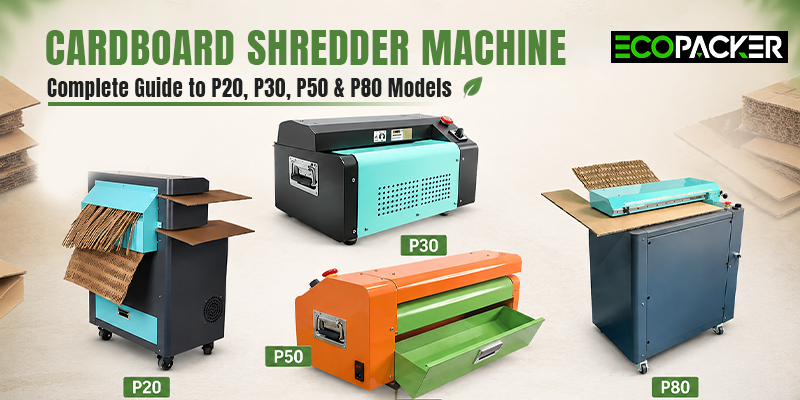
EcoPacker offers four cardboard shredder models — the P20, P30, P50, and P80 each designed for a different scale of operation, from small businesses to high-volume industrial warehouses. In this guide, we’ll break down how these machines work, what sets each model apart, and how to choose the right one for your packaging needs.
What Is a Cardboard Shredder Machine?
A cardboard shredder machine is a packaging device that feeds used cardboard sheets or cartons through an internal cutting or perforating system, transforming flat waste cardboard into flexible, cushioned material. Instead of throwing away used boxes, businesses can feed them directly into the machine and reuse the output as protective void-fill or wrapping material for fragile products.
This approach directly replaces materials like bubble wrap, thermocol, and plastic air pillows, all of which come with higher recurring costs and a larger environmental footprint. For e-commerce sellers shipping electronics, glassware, or other delicate items, this translates into real, measurable savings every month.
How a Cardboard Shredder Machine Works
The operating principle is straightforward across all models:
- Feed — A flattened cardboard sheet or carton is inserted into the machine’s feed opening.
- Cut/Perforate — Internal blades or rollers cut and shape the cardboard into a flexible, honeycomb-like structure.
- Output — The shredded or perforated cardboard emerges ready to use as cushioning, wrapping, or void-fill material.
The result is a shock-absorbing packaging material produced entirely from cardboard your business already has on hand, eliminating the need to purchase separate protective packaging supplies.
P20, P30, P50 & P80 – Understanding the Model Range
EcoPacker’s shredder lineup is structured around feed width and output capacity, allowing businesses of different sizes to pick a machine that matches their actual packaging volume rather than overpaying for capacity they don’t need.
P20 Cardboard Shredder
The P20 is positioned as the entry-level option in the range, suited to smaller businesses, home-based e-commerce sellers, and low-to-moderate daily packaging volumes. It’s a practical starting point for businesses that want to move away from bubble wrap without investing in a full industrial setup.
P30 Cardboard Shredder
The P30 steps up in capacity with a wider feed opening available in 35cm, 45cm, and 55cm cutting width options and supports cardboard thickness up to 10mm. It runs on either 110V or 220V power, making it flexible for different facility setups. This model is built for warehouses, e-commerce fulfilment centres, and logistics operations that need reliable daily output without the footprint of a large industrial machine.
P50 Cardboard Shredder
The P50 moves further up the capacity range, designed for businesses processing higher daily cardboard volumes. It suits growing fulfilment operations and mid-sized warehouses where packaging demand is consistent and higher throughput is needed to keep pace with daily shipping.
P80 Cardboard Shredder
The P80 is the heavy-duty option in the lineup, built for high-volume industrial and logistics environments. Businesses running large-scale fulfillment centers or manufacturing facilities with substantial daily cardboard waste will find this model best equipped to handle continuous, high-output operation.
Note: Exact specifications can vary by configuration — it’s best to confirm current technical details and pricing for each model directly with the EcoPacker team based on your specific packaging volume.
Key Benefits of Using a Cardboard Shredder Machine
- Lower Packaging Costs: Reusing cardboard waste as cushioning material significantly cuts spending on bubble wrap, foam, and void-fill supplies.
- Reduced Waste: Diverting cardboard from disposal bins supports better warehouse waste management and sustainability goals.
- Reliable Product Protection: The shredded output provides genuine shock-absorbing cushioning for fragile items during transit.
- Compact, Space-Saving Design: These machines are built to fit into existing warehouse or packing station layouts without requiring major floor space.
- Energy-Efficient Operation: Designed for daily use with minimal power consumption relative to output.
- Improved Brand Image: Businesses that switch to eco-friendly packaging materials often see stronger customer trust and positive feedback, especially among sustainability-conscious buyers.
How to Choose the Right Model for Your Business
Selecting between the P20, P30, P50, and P80 comes down to a few practical factors:
1. Daily Packaging Volume Estimate how much cardboard waste your operation generates daily and how many shipments you pack. Lower volumes are well served by the P20, while high-volume fulfilment centres should look toward the P50 or P80.
2. Available Floor Space: Smaller businesses or packing stations with limited space should prioritise compact models, while larger operations with dedicated packaging areas can accommodate bigger machines comfortably.
3. Type of Products Shipped If you’re shipping predominantly fragile items electronics, glassware, ceramics a higher-capacity model ensures you can produce enough cushioning material without bottlenecking your packing line.
4. Budget and ROI Timeline Every model pays for itself over time by eliminating the recurring cost of bubble wrap and foam. Businesses with tighter upfront budgets can start with the P20 or P30 and scale up as packaging volume grows.
5. Power Setup Check your facility’s available voltage and confirm compatibility, as some models offer flexible voltage configurations while others are built for a specific setup.
Cardboard Shredder Machine Price – What to Expect
Pricing for a cardboard shredder machine varies based on the model, feed width, and cutting capacity. Entry-level models like the P20 are priced more accessibly for smaller operations, while the P50 and P80 command a higher investment in line with their increased throughput and heavier-duty build. While the upfront cost is higher than a basic paper shredder, businesses typically recover this investment within a few months through reduced spending on bubble wrap and other protective packaging materials. For an accurate, up-to-date price list based on your specific requirements, it’s best to reach out to the EcoPacker team directly.
Cardboard Shredder vs Traditional Packaging Materials
| Factor | Cardboard Shredder Output | Bubble Wrap / Foam |
| Material Source | Reused waste cardboard | Purchased plastic materials |
| Recurring Cost | Low (uses existing waste) | High (ongoing purchase needed) |
| Environmental Impact | Low – biodegradable, reused material | High – plastic waste |
| Storage Requirement | Minimal, produced on demand | Requires bulk storage |
| Cushioning Performance | Strong, shock-absorbing | Strong, but plastic-based |
Where to Use the Cardboard Output
The material produced by a cardboard shredder machine isn’t limited to a single use case. Depending on how it’s cut and shaped, the output works well as:
- Void-fill for gaps inside shipping boxes, preventing products from shifting during transit
- Wrapping layer around fragile items like glassware, ceramics, and electronics
- Cushioning padding at the base and sides of boxes to absorb impact during handling
- General protective filler for pallet shipments and bulk orders
This versatility means a single machine can serve multiple packaging stations across a warehouse, reducing the need to stock several different protective materials for different product types.
Conclusion
Whether you’re a small e-commerce seller or a large-scale logistics operation, there’s a cardboard shredder machine in the P20, P30, P50, and P80 range built to match your packaging volume. These machines offer a practical way to reduce packaging costs, cut down on plastic use, and turn everyday cardboard waste into genuinely useful protective material.
If you’re ready to explore which model fits your business best, EcoPacker team can walk you through the full range, current specifications, and pricing to help you make the right choice for your warehouse or fulfilment operation.
Frequently Asked Questions
The primary difference lies in feed width and output capacity. The P20 suits smaller operations, the P30 and P50 handle moderate-to-high daily volumes, and the P80 is built for high-volume industrial use.
For most fragile items, yes. The shredded cardboard output provides strong shock-absorbing cushioning that performs comparably to bubble wrap for everyday shipping needs.
Capacity varies by model — for example, the P30 supports cardboard thickness up to 10mm. It’s best to confirm exact specifications for each model based on the type of cardboard you typically use.
Yes, the P20 is designed as an accessible entry point for smaller operations that want to reduce packaging costs without investing in industrial-scale equipment.
Most businesses recover their investment within a few months, depending on their daily packaging volume and how much they previously spent on bubble wrap or foam packaging materials.
Eco-Friendly Packaging
Interested in the Eco-Packer Machine?
Fill out our inquiry form and our team will get back to you within 24 hours.
