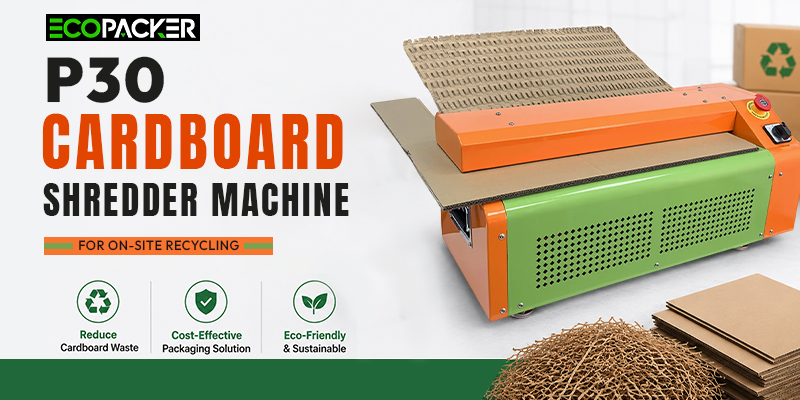
Walk into almost any manufacturing unit today, and you’ll find the same recurring problem stacked up near the loading dock: piles of used cardboard cartons, packaging offcuts, and shipping boxes with nowhere productive to go. Most facilities either pay to have this waste hauled away or let it pile up until it becomes a storage and safety issue. The P30 Cardboard Shredder Machine is changing that equation entirely, giving manufacturing units a way to recycle cardboard waste on-site and turn it into something genuinely useful.
This isn’t just a sustainability talking point anymore. Manufacturers across warehousing, logistics, and production environments are actively installing shredding systems like the P30 to solve a real operational problem, and the results are showing up directly on their packaging budgets.
The Cardboard Waste Problem in Manufacturing Units
Every plant that gets raw parts in large loads ends up with a steady supply of cardboard. If you add up the deliveries each day, it can turn into a lot of waste each week. In bigger setups, it may even happen every day.
Most of the time, people handle it in two ways. They bale it and send it to recyclers, where it brings only small returns. Or they toss it and let it go to landfill. In both cases, the plant misses a simple point. The cardboard can be shredded and used again as padding for items going out. That way, it stays in the same site and helps close the loop.
This is exactly where a cardboard shredder machine changes the equation for manufacturers who ship finished products regularly.
What the P30 Cardboard Shredder Machine Actually Does
The P30 cardboard shredder is a strong machine for cutting up thick cardboard. It has a 550 mm feed opening. It is made to take big sheets, plus boxes, and turn them into soft cushioning material. This helps replace the need to throw away used cartons. The cartons go right into the unit, and the shredder turns them into a crumpled, bouncy texture. That texture works well for filling empty space and for protecting packed items.
It can take cardboard up to 10 mm thick. So it can shred typical shipping cartons and also heavier corrugated pieces. These are the kinds often found in industrial supply workflows. The unit comes with power options for 110V or 220V. That means it can fit most factory electrical setups. Setup should be easier for sites of different sizes.
How Manufacturing Units Use the P30 for On-Site Recycling
Step 1: Collecting Incoming Cardboard Waste
Most manufacturing units already have a receiving area where raw materials and components arrive in cardboard packaging. Instead of sending this waste directly to a scrap bin, facilities set up a dedicated collection point near the P30 Cardboard Shredder Machine so cartons can be broken down and fed in as soon as they’re emptied.
Step 2: Shredding Into Protective Cushioning Material
Once collected, the cardboard is fed through the P30’s 550mm opening, where the industrial-grade cutting system converts it into cushioning material. This process happens quickly enough to keep up with daily operational volume, without requiring a dedicated full-time operator in most mid-sized facilities.
Step 3: Reusing the Output for Outbound Packaging
The shredded cardboard is then stored and used directly as void-fill and cushioning for outbound shipments. For manufacturers who both receive raw materials and ship finished products, this creates a closed-loop system where incoming packaging waste becomes outgoing packaging protection, with almost no material cost involved.
Step 4: Reducing Dependency on External Packaging Materials
As this cycle becomes routine, manufacturing units naturally reduce their reliance on purchased packaging materials like bubble wrap, foam sheets, and plastic void-fill. Over time, this shift alone can account for a meaningful reduction in monthly packaging expenditure.
Why This Matters for Manufacturing Operations
Lower Packaging Costs
Bubble wrap and plastic-based cushioning materials aren’t cheap, especially at industrial volumes. By converting existing waste cardboard into usable packaging, manufacturers cut down on a recurring purchase cost that otherwise scales directly with shipment volume. An industrial cardboard shredder essentially turns a waste-disposal expense into a packaging-supply asset.
Reduced Waste Disposal Costs
Many manufacturing units pay per pickup or per tonnage for cardboard waste removal. When a significant portion of that waste is processed on-site instead, disposal volumes drop, which directly reduces recurring waste management costs.
Improved Space Utilisation
Loose, unshredded cardboard takes up considerably more floor and storage space than processed material. A cardboard shredding machine compacts this waste into a usable form, freeing up valuable floor space near receiving and shipping areas something that matters a lot in facilities where every square foot counts.
Supporting Sustainability Commitments
More manufacturers today are under pressure from clients, investors, and regulations to demonstrate real sustainability practices, not just statements. A cardboard recycling machine like the P30 provides a tangible, measurable way to show reduced landfill contribution and lower reliance on plastic packaging, which increasingly matters in vendor audits and ESG reporting.
Where the P30 Fits Best in a Manufacturing Facility
Put the P30 cardboard shredder near the receiving dock and also close to the packing or dispatch area. This cuts the travel time for cardboard between the drop off point and the next stage. That helps the line move without extra steps.
Teams that deal with large loads often get results sooner. This includes makers of auto parts, electronics assembly sites, industrial equipment plants, and FMCG packing operations. With that much cardboard waste, shredding on site can start paying off right away.
Smaller factories can still use the same setup. The payoff just takes longer when cardboard flow is low. In those places, it can work better to run one shredder station for several departments. That approach is often more practical than placing a unit at each dispatch spot.
Maintenance and Operational Considerations
Any shredder, even one built for heavy work, needs plain upkeep. If you wipe down the cutter area and keep it clear of sticky tape or label glue, the output stays steady instead of slowing down. Also, do not push in cardboard that is thicker than the stated 10mm limit. When you exceed that level, the cutting parts can take extra stress.
For most sites, a short daily clearing of leftover bits is enough. It helps reduce buildup during long runs. Teams should also take a moment to check the blades from time to time. That routine keeps the machine dependable during busy shifts.
A Practical Example: What On-Site Recycling Looks Like Day to Day
Consider a mid-sized component manufacturing unit that receives around 200 cardboard cartons a week from suppliers and ships roughly the same number of finished units to distributors. Before installing a shredding system, this facility paid for weekly waste pickup and separately purchased bubble wrap for outbound shipments – two ongoing costs tied to the same material.
After introducing the P30 Cardboard Shredder Machine near the receiving dock, incoming cartons are broken down and shredded as soon as they’re unpacked, rather than piling up until collection day. The shredded output is stored in bins next to the dispatch area, ready to use whenever an outbound shipment needs cushioning. Within a few weeks, the facility noticed two clear changes: the waste pickup volume dropped noticeably, and packaging material purchase orders became far less frequent.
This kind of setup doesn’t require a dedicated operator or a major workflow overhaul. It simply shifts cardboard handling from “dispose and repurchase” to “process and reuse”, which is really the core value a cardboard recycling machine brings to a manufacturing environment.
Safety and Workplace Benefits Beyond Cost Savings
On-site shredding also addresses a workplace hazard that’s easy to overlook. Loose cardboard piles near receiving docks can become tripping hazards and fire-load risks that slow down daily operations. Processing cardboard immediately after it’s emptied, rather than letting it accumulate, keeps walkways and work areas clearer, a benefit that facility safety officers often value as much as the cost savings itself.
Making the Business Case for On-Site Recycling
For operations or facilities managers evaluating whether to invest in this kind of equipment, the calculation is fairly straightforward. Add up the current monthly spend on packaging materials like bubble wrap and foam, along with cardboard disposal costs, and compare that against the one-time investment in a cardboard shredder machine. For most mid-to-large manufacturing units, the payback period is measured in months, not years, particularly once disposal savings are factored in alongside packaging material savings.
There’s also an operational resilience angle worth considering. Facilities that rely entirely on external packaging suppliers are vulnerable to supply chain disruptions or price increases. Generating a portion of packaging material internally through an industrial cardboard shredder reduces that dependency, giving manufacturing units more control over a part of their supply chain that’s often overlooked.
Conclusion
On-site cardboard recycling isn’t just an environmental checkbox anymore; it’s becoming a practical, cost-saving operational strategy for manufacturing units of every size. The P30 Cardboard Shredder Machine gives facilities a straightforward way to convert an ongoing waste problem into a genuine packaging solution, cutting costs on two fronts: reduced packaging material purchases and lower waste disposal expenses. For manufacturers looking to build a more sustainable, self-sufficient packaging process, the P30 Cardboard Shredder Machine from EcoPacker offers a practical starting point worth evaluating.
Frequently Asked Questions
1. Can the P30 Cardboard Shredder Machine handle heavy industrial cardboard?
Yes, the P30 Cardboard Shredder Machine supports cardboard thicknesses of up to 10 mm, making it suitable for most industrial-grade cartons and corrugated packaging used in manufacturing units.
2. How much can a manufacturing unit save by using this machine?
Savings vary by cardboard volume, but manufacturers typically reduce spending on bubble wrap and void-fill materials while also lowering cardboard disposal costs, making the payback period relatively short for high-volume facilities.
3. Does operating this shredder require special training?
No specialized training is required; the P30 is designed for straightforward operation, and most facility staff can be trained to use it safely within a short orientation session.
4. Is the P30 suitable for small manufacturing units with lower cardboard waste?
Yes, though smaller units may see a longer payback period. In such cases, a shared shredding station serving multiple departments is often a practical approach.
5. What voltage does the P30 Cardboard Shredder Machine require?
The machine is available in 110V or 220V configurations, making it compatible with most standard industrial power setups across different regions.
Eco-Friendly Packaging
Interested in the Eco-Packer Machine?
Fill out our inquiry form and our team will get back to you within 24 hours.
