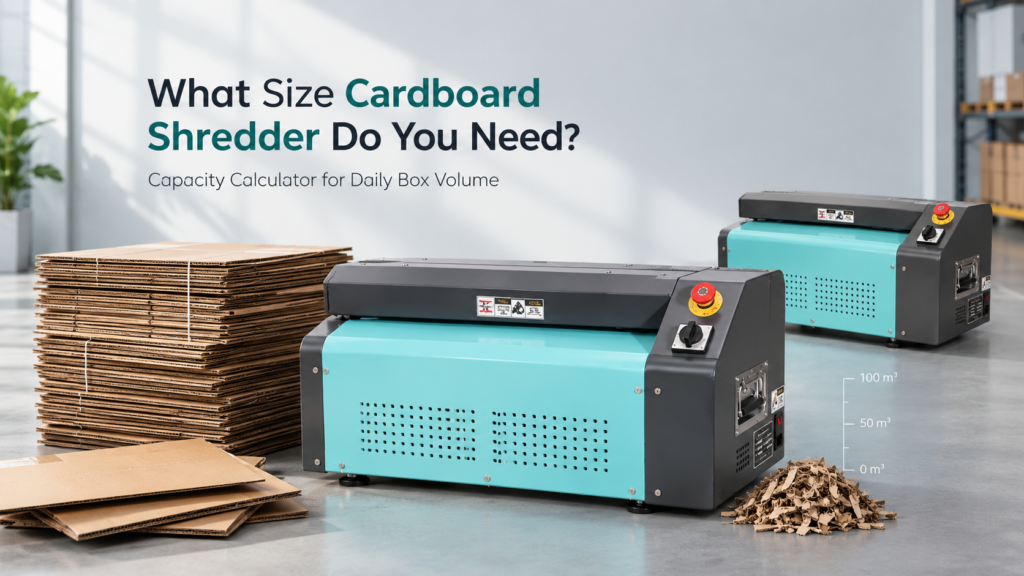
Getting a cardboard shredder is not usually the hard part. Most people can place an order and move on. The real trouble is picking the right size. If the shredder is small, it will slow your work at the packing bench. If it is too large, you will end up paying for extra power you do not need.
To choose well, you should focus on shredder capacity based on what you do each day. Start with how many boxes you get. Then look at how many parcels you send out. Also note how thick your cardboard is.
Use this guide to run a quick four-step check. You can do it with a pen and a simple weighing scale. After that, compare the EcoPacker P20, P30, P50-X, and P80 models. Pick the one that fits your daily box amount.
Why Machine Size Matters
A cardboard shredder machine turns used cartons into flexible cushioning and void fill, so you can stop buying bubble wrap and foam. But every model is built for a different workload:
- Too small: the operator waits for cushioning while parcels pile up, especially in peak season.
- Too large: higher purchase cost, more floor space and more power than your volume needs.
- Wrong board handling: if your cartons are thicker than the machine supports, the shredder jams, or you have to pre-cut boxes by hand.
Sizing the machine properly from day one avoids all three problems.
Step 1: Measure How Much Cardboard Waste You Have Per Day
Start with supply. Ask: how much cardboard waste per day does my business actually generate?
Formula: Boxes received per day × average weight of one empty box (kg) = cardboard waste per day (kg)
Weigh five or six empty cartons from your usual suppliers and take the average. Do not guess, because a flattened carton weighs more than most people expect.
Example (illustrative numbers): you open 40 cartons a day and each weighs 0.5 kg. That gives you 40 × 0.5 = 20 kg of cardboard waste per day.
Step 2: Work Out How Much Cushioning You Need
Now look at demand. How much protective material do your parcels really use?
Formula: Parcels shipped per day × cushioning used per parcel (kg) = cushioning needed per day (kg)
If you currently use bubble wrap, weigh what goes into a typical parcel. Fragile items like glassware, ceramics and electronics usually need more than garments or books. If you are not sure how much padding a product needs, read our guide on how to calculate the right cushioning thickness for fragile products.
Example (illustrative numbers): you ship 150 parcels a day and each uses about 80 g (0.08 kg) of cushioning. That gives you 150 × 0.08 = 12 kg of cushioning needed per day.
Turning cardboard waste to cushioning only works smoothly when supply and demand are close. In our example you have 20 kg of waste and need 12 kg, so supply covers demand. If your waste is much lower than your demand, you will need to top up with bought cardboard or consider a paper cushion machine that runs on paper rolls.
Step 3: Check Board Thickness and Cutting Width
This is the step many buyers skip. Volume tells you how long the machine must run, but thickness and width decide whether it can handle your boxes at all.
As a rough guide, single-wall corrugated board is around 3 to 5 mm thick, double-wall around 6 to 9 mm, and triple-wall around 12 to 16 mm. Measure your own cartons, and if you are unsure what grade you use, our explainer on cardboard grades and packaging strength will help.
Here is what each EcoPacker shredder supports, based on the specifications on each product page:
| Model | Cutting width | Max board thickness | Voltage options | Best suited for |
| P20 | 450 mm (35/45/55 cm options listed) | Up to 10 mm | 110V / 220V | Small sellers, startups, compact packing tables |
| P30 | 550 mm (35/45/55 cm options listed) | Up to 10 mm | 110V / 220V | Growing e-commerce brands, small warehouses |
| P50-X | 550 mm | Up to 15 mm | 110V / 220V / 380V | Busy warehouses, logistics and manufacturing units |
| P80 | 550 mm | Up to 20 mm | 110V / 220V / 380V | Heavy board, high-volume, continuous operation |
If most of your cartons are single-wall or light double-wall, the P20 or P30 will handle them. If you regularly receive heavy double-wall or triple-wall cartons, move up to the P50-X or P80.
Step 4: Convert Volume Into Machine Running Time
Finally, check how long the machine must run each day. This depends on the shredder machine kg/hr, which is the amount of cardboard a model can process in an hour. Output varies with the model and the type of board, so ask our team for the kg/hr figure of the model you are considering and, if possible, test it with your own cartons.
Formula: Cushioning needed per day (kg) ÷ machine output (kg/hr) = running hours per day
Example (illustrative output of 20 kg/hr, not a rated figure):
- Normal day: 12 kg ÷ 20 kg/hr = 0.6 hours, or about 36 minutes of shredding.
- Festive peak at double volume: 24 kg ÷ 20 kg/hr = 1.2 hours, or about 72 minutes.
If the running time fits comfortably inside your packing shift, the machine is big enough. If it needs more than half your working day just to keep up, step up one size.
Quick Sizing Guide by Business Type
Use this table as a starting point, then confirm with your own numbers from Steps 1 to 4.
| Your situation | What to look for | Likely fit |
| Home-based or small online seller, light cartons | Compact machine, basic power supply | P20 |
| Growing e-commerce brand, daily dispatch, mostly single-wall boxes | Wider feed, reliable daily use | P30 |
| Warehouse or 3PL with heavier cartons and long shifts | 15 mm board handling, 380V option | P50-X |
| Manufacturer or fulfilment centre with thick board and continuous running | 20 mm board handling, industrial build | P80 |
Not sure which row is yours? Our complete guide to the P20, P30, P50 and P80 models compares them in more detail.
Common Sizing Mistakes to Avoid
- Choosing on width alone. A wide feed does not help if the board is thicker than the machine supports. Check thickness first.
- Planning for the average day. Size for your busiest month. Diwali and sale-season spikes can double your parcel count overnight.
- Ignoring the power supply. The P50-X and P80 offer a 380V option, which usually means a three-phase connection. Confirm what your premises have before you order.
- Forgetting the supply side. A bigger machine does not create more waste cardboard. If your boxes are fewer than your demand, no shredder will close the gap.
- Skipping maintenance planning. Even the right machine needs regular care. Here is how to set up and maintain your cardboard shredder P80 for a long working life.
Get the Right Machine for Your Volume
You now have the four numbers that matter: cardboard waste per day, cushioning needed per day, board thickness and running time. Share them with us, and our team will recommend the right model and share the exact output for your cartons.
Browse the full EcoPacker collection or contact our team to get a recommendation based on your daily box volume.
Frequently Asked Questions
Which cardboard shredder is best for a small online seller?
For light cartons and a compact setup, the P20 is the usual starting point. If you expect fast growth, the P30 gives you a wider feed to grow into.
Can a cardboard shredder fully replace bubble wrap?
For most products, yes. Shredded cardboard cushioning is shock-absorbing and works well as void fill. See why many sellers are switching from plastic bubble wrap to cardboard packaging.
What if I do not generate enough waste cardboard?
Compare your numbers from Steps 1 and 2. If demand is higher than supply, you can collect extra cartons or look at a paper-based cushioning solution instead.
Do EcoPacker machines come with a warranty?
Yes. EcoPacker offers a one-year warranty along with lifetime technical support and after-sales service.
