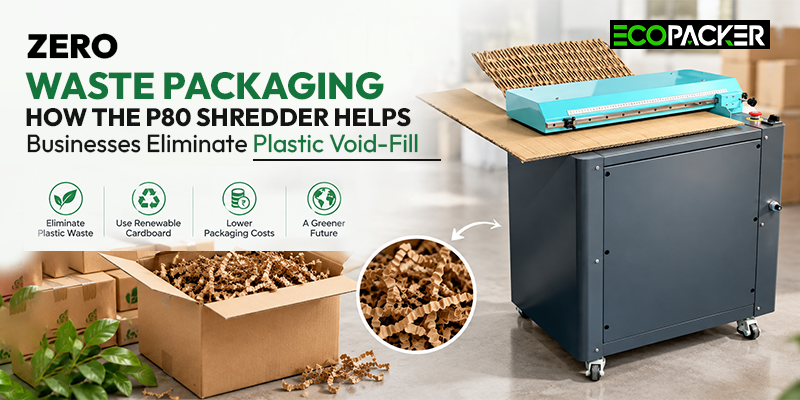
Every business that ships products faces the same daily problem: what to do with empty cardboard boxes, and what to use to protect fragile items during transit. For years, the default answer was plastic bubble wrap, foam sheets, air pillows, and thermocol. But plastic void-fill is expensive, hard to recycle, and adds to the growing waste problem in Indian warehouses and fulfilment centres.
This is where a P80 cardboard shredder changes the equation. Instead of throwing away used cartons and buying plastic packaging separately, businesses can now convert their own waste cardboard into cushioning material on-site. This one shift moves a company closer to zero-waste packaging while cutting recurring costs. In this blog, we will look at what this kind of machine does, how it works, its key features, and how it compares with traditional plastic void-fill, in simple and accurate terms.
What Is a Cardboard Shredder Machine?
A cardboard shredder machine, which can also be referred to as a cardboard perforator, is a machine used in the industry where it perforates or cuts waste cardboard material into a netting or honeycomb pattern. The honeycomb pattern allows the cardboard material to have flexibility and springiness properties like bubble wrap and hence be used to wrap products or fill boxes.
While a regular paper shredder machine may just cut up the cardboard materials randomly, a specialized machine for cardboard cushioning will create a consistent pattern on the material making it durable to cushion delicate items such as glass, electronic devices, and ceramic ware while packaging. A cardboard shredder machine in India that would be chosen should therefore fall under this category.
How Does It Work?
The process itself is straightforward:
- Flattened or lightly folded waste cartons are fed into the machine’s intake slot.
- Internal rollers or cutting blades perforate the cardboard in a honeycomb or wave pattern instead of cutting it into pieces.
- The perforated sheet comes out the other side, ready to be folded, rolled, or wrapped around a product.
- The finished material is used directly as cushioning, or as a filler to occupy empty space inside a shipping box.
Because the whole cycle takes place at the packing table, there is no waiting for stock deliveries of bubble wrap or foam the input (used cartons) is something every warehouse already has in abundance.
Key Features of a High-Capacity Cardboard Shredder
Most P80 class machines, which include heavy duty industrial machines meant for continuous usage, have common features. Here are the features that should be considered in a P80 class cardboard shredder when determining its suitability for a packing process:
- High capacity: Designed to handle continuous streams of cartons on a daily basis, appropriate for warehousing facilities and fulfilment centers handling many shipments each day.
- Wide feed entry: Most industrial machines, especially the 550mm cardboard shredder version, can accept bigger pieces of cardboard without the need for prior cutting.
- Perforates thicker cartons: Can perforate multilayered and rigid cardboard that can be challenging to perforate for desktop machines.
- Output adjustment width: Enables users to adjust the final width of the cushioning strip as required for boxes of various sizes and shapes.
- Continuous-duty motor: Can handle long periods of continuous usage without overheating, as opposed to consumer grade shredders.
- Compact design: Compact machine that can easily fit into an existing packing line and does not need an additional room.
- Safety features: Machines in this class have safety features like emergency stop buttons among others.
- Silent and dust-free: They have been designed to work in an active packing area amidst workers.
Why a Cardboard-to-Cushioning Machine Makes Sense for Indian Businesses
The daily quantity of cardboard waste produced by India’s e-commerce and logistics industry is immense, and most of it is either discarded or recycled for scrap after just one use. Simultaneously, companies invest money in purchasing plastic bubble wrap, foam, and packing peanuts to prevent damage during shipment.
The cardboard-to-cushioning machine resolves both these issues:
- It reduces the volume of cardboard sent out as waste, since the same carton is reused as protective packaging.
- It reduces or removes ongoing spending on plastic void-fill materials.
- It supports compliance with tightening rules around single-use plastic packaging in several Indian states.
- It gives brands a genuine sustainability story to share with environmentally conscious customers.
For sellers of fragile goods glassware, electronics, ceramics, cosmetics in glass bottles this is particularly relevant, since breakage during transit is a direct cost, and plastic cushioning is often the biggest recurring packaging expense.
P80 Cardboard Shredder vs Plastic Void-Fill: Summary of Differences
It helps to see the two approaches side by side before deciding what fits a particular operation.
| Factor | P80 Cardboard Shredder Output | Plastic Void-Fill (Bubble Wrap/Foam) |
| Raw material | Waste cardboard already on-site | Purchased separately, ongoing cost |
| Environmental impact | Biodegradable, recyclable | Non-biodegradable, hard to recycle |
| Recurring cost | Low, mainly electricity and maintenance | Recurring purchase cost per kg |
| Storage space | Cardboard stored as flat sheets until shredded | Bulky rolls need dedicated storage |
| Cushioning performance | Comparable for most general and semi-fragile items | Slightly better for extremely delicate or heavy items in some cases |
| Waste generated | Converts existing waste into usable material | Adds new plastic waste to the supply chain |
| Regulatory outlook | Aligns with plastic-reduction rules | Increasingly restricted in several categories |
In short, a machine-based approach turns a cost centre (cardboard disposal) into a packaging solution, while plastic void-fill remains a pure expense with an added disposal problem down the line.
Cost and Operational Considerations
A few considerations that need to be made prior to purchasing the machinery in question are as follows:
- Daily amount of cardboard: It is important to determine how much cardboard a company produces and whether it will justify investment in an expensive high-capacity cardboard shredder 550mm.
- Space at the packing station: Any kind of industrial machinery needs floor space and accessible entry.
- Power supply: The power supply must be considered in case it requires voltage increase.
- Machine maintenance: It is important to check the blades and rollers on a regular basis.
- Employees: Training for employees is important for proper and safe operation.
Businesses researching this category of machines, including website such as EcoPacker India, will note that most EcoPacker packaging machines and other types of cardboard perforators are built according to the same main concept converting a company’s cardboard waste into packaging materials, instead of buying from plastic packaging suppliers.
Environmental Impact Beyond the Packing Table
The advantage of moving to cardboard as a cushioning material is not just in the individual shipment. On a monthly scale with thousands of packages shipped, this results in:
- Less plastic waste in landfills and waterways
- Lower need for virgin plastic production
- Lower shipping weight and space used for recycling of packaging, given that the system of cardboard recycling is established
- An easier process of disposing of the packaging material for end users
Such an approach to operations will be beneficial for those companies which strive for sustainability and report on their progress through ESGs.
Conclusion
Cardboard recycling and plastic void fill are two issues that businesses have traditionally dealt with in isolation, where one goes in the trash, while the other comes in the form of an invoice from the supplier. The P80 cardboard shredder solves these two issues in one solution, making the cardboard sitting in the warehouse useful as packing material for the next shipment.
For businesses considering their options, knowledge of machine capacity, feed width (for example, 550 mm cardboard shredder), and volume of cardboard is crucial when deciding on appropriate machinery. When done properly, this move lowers ongoing packaging costs, decreases the reliance on plastic, and helps to move towards zero waste packaging
If you want to try this for your own business, EcoPacker makes cardboard machines built for this exact job. It’s a great place to start if you’re looking for an easy, eco-friendly way to pack your products. .
Frequently Asked Questions
1. What is a P80 cardboard shredder used for?
The cardboard shredder P80 cardboard shredder is utilized in order to turn old carton boxes into a honeycomb-like sheet form that acts as packing material. Rather than sending waste cardboard boxes to the garbage can, warehouses will feed them through the machine and reuse them as packing material for fragile objects, thus helping minimize wastage of cardboard as well as plastic packing material.
2. Is a cardboard shredder machine better than bubble wrap?
In terms of protection, cardboard packaging is about as effective as bubble-wrap when considering regular and semi-delicate cargo, while also being more environmentally friendly and more cost-effective in the long term due to the recycling of the material that is already present at the location. Particularly fragile or heavy cargo can still require some extra packing.
3. What thickness of cardboard can these machines handle?
The capacity differs from one machine to another, but it is common for industrial-strength machines to be capable of perforating multi-layer corrugated cardboard, which would not be possible using light-weight, desk-top machines. The crucial point to consider is whether the machine has the capability of handling cardboard with particular feed width, like 550mm cardboard shredder.
4. Is this type of machine suitable for small businesses?
Certainly, though obviously the size required would depend on the amount of cardboard generated on a daily basis. Smaller firms would manage well with smaller desk top models whereas those with higher shipments would benefit from more robust industrial capacity equipment. It makes sense to consider the daily amount of cardboard waste generated.
5. Does switching to cardboard cushioning actually reduce costs?
In the long run, however, the answer is definitely yes since the raw material being cardboard that the business has been receiving all along as opposed to a purchased plastic product that must be bought time after time. The initial expense will only entail the cost of the machine, its upkeep, and power supply.
Eco-Friendly Packaging
Interested in the Eco-Packer Machine?
Fill out our inquiry form and our team will get back to you within 24 hours.
