Introduction: The Bubble Wrap Bill Nobody Talks About
Every Indian e-commerce seller knows the drill. Products arrive at the warehouse. They get wrapped in layer after layer of bubble wrap. Sealed with plastic tape. Packed into an oversized box stuffed with foam peanuts. And shipped to a customer who tears it all open in thirty seconds, dumps everything in a bin, and never thinks about it again.
Across India, thousands of e-commerce businesses are collectively spending crores of rupees annually on plastic protective packaging that serves its purpose for exactly one journey and then becomes someone else’s waste problem. And now with tightening plastic regulations, rising material costs, and consumers who actively prefer eco-conscious brands, the calculation is shifting fast.
The good news is that the alternative is not just better for the environment. It is better for the business. Indian e-commerce sellers who have made the switch to Cardboard Perforation Machine protective packaging are reporting cost savings of 60 to 80 percent on packaging materials, lower product damage rates, and stronger customer satisfaction scores. This is not a trend. It is a structural shift and it is accelerating.
The Real Problem With Plastic Bubble Wrap
Bubble wrap has been the default protective packaging material for decades, and it is easy to understand why. It is cheap to buy in bulk, light, easy to use, and provides decent cushioning for most products. For a long time, there was simply no comparable alternative.
But “cheap to buy” is not the same as “cheap to use.” When you account for the full cost of bubble wrap purchase price, storage space, disposal cost, and the ongoing environmental liability the picture looks very different.
The Regulatory Problem
India’s Plastic Waste Management Rules have been tightening steadily. The 2022 amendment banned several categories of single-use plastic packaging items, and Extended Producer Responsibility (EPR) regulations now require businesses to register with the Central Pollution Control Board and meet collection and recycling targets. Businesses that continue relying heavily on plastic packaging face increasing compliance risk and the regulations are only going in one direction.
The Customer Experience Problem
Consumer attitudes toward packaging have shifted measurably. A 2024 survey of Indian online shoppers found that 67 percent actively preferred brands that used eco-friendly packaging, and 41 percent said they were less likely to reorder from a brand that used excessive plastic packaging. For D2C brands where the unboxing experience is a direct extension of the brand identity, arriving in a mountain of plastic wrap is increasingly a liability.
What Indian E-Commerce Sellers Are Switching To
The most significant shift happening in Indian e-commerce packaging right now is toward cardboard-based protective packaging specifically, packaging produced directly from the waste cardboard that warehouses and fulfillment centers already receive in abundance every day.
This is where the cardboard perforation changes the entire economics of the packaging decision.
What Is a Cardboard Perforation Machine?
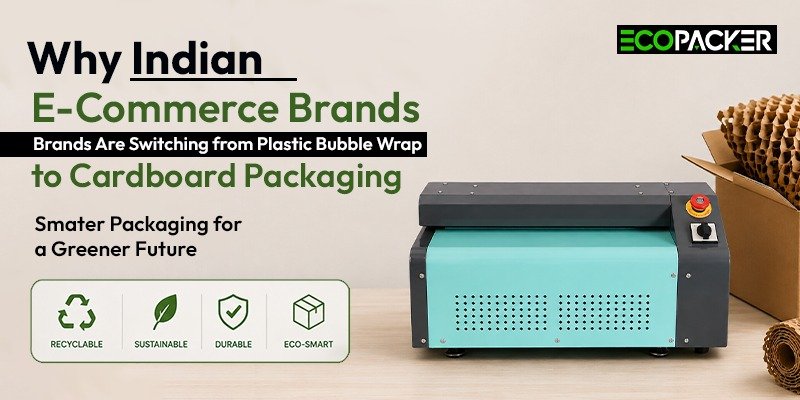
A cardboard perforation machine ike the Eco-Packer takes flat, used cardboard (from incoming shipment boxes, supplier cartons, or any other cardboard waste) and perforates it into a flexible, interlocking honeycomb netting pattern. The output is a continuous, expandable mesh of cardboard that can be wrapped around products, used as void fill, or layered for double protection exactly the same way bubble wrap is used, but at essentially zero material cost after the machine investment.
This is the key distinction that separates a cardboard perforation machine from a standard cardboard shredder. A shredder crushes and cuts cardboard into loose strips or chips useful for void fill but not capable of providing the wrapped, cushioned protection that bubble wrap gives. The perforation process creates a structurally interlocking honeycomb pattern that maintains its shape under pressure, absorbs shock from multiple directions, and wraps around product contours the way bubble wrap does.
The Economics: Why the Switch Makes Financial Sense
The monthly material cost drops to near zero. The machine covers its own cost within four to five months. After month five, every rupee saved on bubble wrap is pure monthly profit improvement compounding month after month, year after year.
For larger operations, logistics companies, large e-commerce warehouses, and FMCG distributors, the payback period is even faster because the volume of both cardboard waste available and bubble wrap being replaced is proportionally higher.
Real Benefits Indian Sellers Are Experiencing After the Switch
Lower Packaging Costs
This is the most immediate and measurable benefit. Businesses report saving between 60 and 85 percent of their previous bubble wrap spend within the first month of deploying a cardboard perforation. The ongoing cost is essentially the electricity to run the machine, which is designed to be energy-efficient, and the labour time to feed cardboard and wrap products, which is comparable to the time previously spent handling bubble wrap rolls.
Reduced Product Damage and Returns
Here is something that surprises most sellers when they first hear it: perforated cardboard honeycomb netting provides superior shock absorption to standard bubble wrap for most product categories. The honeycomb structure distributes impact energy across a wider area than the individual air pockets in bubble wrap, which can burst under sharp impact and leave the product unprotected.
Sellers in the electronics, glassware, and ceramics categories who have switched consistently report lower breakage rates typically 30 to 50 percent fewer damaged product returns after making the switch. When you factor in the cost of replacing damaged products and managing returns, this is often a larger financial benefit than the direct material cost saving.
Better Brand Perception and Customer Experience
The unboxing experience has become a genuine competitive differentiator in Indian e-commerce. Customers who receive their order wrapped in neat cardboard netting rather than crumpled plastic sheets notice, and they associate it with a brand that cares about quality and the environment. Several D2C brands have reported positive unboxing mentions on social media directly attributing the packaging to their eco-friendly credentials after switching to cardboard packaging.
Waste Becomes an Asset
Perhaps the most psychologically satisfying shift for warehouse managers and business owners who make the switch: the piles of incoming cardboard that used to be a waste management problem become a raw material. Every box that arrives from a supplier is no longer waste to be collected and disposed of; it is packaging material waiting to be processed through the cardboard perforation machine and turned into value.
Which Businesses Benefit Most from Cardboard Packaging Machines?
Not every business is the right fit, and it is worth being honest about this. The cardboard perforation machine delivers its best ROI for businesses that meet a few specific criteria:
E-commerce sellers of fragile products: electronics, glassware, ceramics, kitchenware, cosmetics, candles, artisan products, and anything else that needs reliable cushioning during transit. These are the sellers spending the most on bubble wrap today.
Businesses receiving significant cardboard inflow: Any business that receives regular deliveries in cardboard boxes has a free supply of raw material. The more cardboard a business receives, the more packaging material it can produce at zero cost.
Operations with consistent daily shipping volumes: Businesses shipping 30 or more orders per day benefit most, as the machine output matches daily packaging demand consistently.
D2C and premium brands: Brands where the unboxing experience is a deliberate part of the customer relationship benefit from the premium, plastic-free presentation that cardboard packaging creates.
Paper Cushion and Paper Bubble Wrap Complementary Solutions
For products that require a softer, lighter cushioning material, paper-based alternatives complement cardboard packaging beautifully. Paper cushion machines produce crumpled kraft paper that wraps individual products and lines box interiors. Paper bubble wrap machines create a paper-based bubble structure that provides comparable protection to plastic bubble wrap for lighter items.
Together, the Ecopacker range the perforation machine, cardboard shredders (P20, P30, P50, and P80 models for different volume requirements), paper cushion machine, and paper bubble machine gives Indian businesses a complete, plastic-free packaging ecosystem that handles every product type, every order size, and every operational scale.
What the Packaging Industry Trend Data Tells Us
India’s e-commerce packaging market is projected to reach ₹72,000 crore by 2027. Within that, eco-friendly packaging is the fastest-growing segment growing at 28 percent annually compared to 18 percent for conventional packaging. Regulatory pressure, consumer preference, and operational economics are all pushing in the same direction at the same time.
The businesses making the switch now are building a structural cost and brand advantage over competitors who will be forced to make the same switch in two to three years but at higher material costs and under greater regulatory pressure.
How to Get Started
If you are an Indian e-commerce business currently spending on bubble wrap and receiving regular cardboard inflows, the starting point is simpler than most people expect.
Request a free sample of perforated cardboard output from Ecopacker use it on your actual products to test protection and fit before making any commitment. This is something Ecopacker actively offers, because the team understands that seeing the output on your specific products is the most convincing argument of all.
From there, the calculation is straightforward: measure your current monthly bubble wrap spend, estimate your daily cardboard inflow, and compare to the machine investment. For most businesses in the target profile, the numbers make the decision for themselves.
Conclusion
The shift from plastic bubble wrap to cardboard-based protective packaging is not driven by environmental idealism alone though the environmental benefits are real and significant. It is driven by economics, regulatory reality, and a customer base that has started paying attention to what brands use to protect their products.
The cardboard perforation machine from Ecopacker sits at the center of this shift for Indian e-commerce businesses. It converts a waste problem into a packaging solution, eliminates a recurring material cost, and delivers protection that matches or exceeds what bubble wrap provides all from a compact, energy-efficient machine designed specifically for the Indian warehouse environment.
For businesses ready to make the switch, Ecopacker by Hakuna Matata Retail Pvt. Ltd. offers the complete range from the core Cardboard Perforation Machine to the full P20–P80 Cardboard Shredder lineup, Paper Cushion Machine, Paper Bubble Machine, and Automatic Wrapping Machine making plastic-free packaging genuinely accessible for Indian businesses of every size.
Frequently Asked Questions (FAQs)
Yes for most electronics and glassware applications, perforated cardboard honeycomb netting provides comparable or superior protection to standard bubble wrap. The honeycomb structure distributes impact energy across a wider area than the individual air pockets in bubble wrap, which can burst under sharp localised impact. Sellers of electronics, glass bottles, ceramic products, and similar fragile items consistently report lower breakage rates after switching to cardboard perforation output. For your specific products, Ecopacker offers free sample output so you can test protection on your actual inventory before committing.
A reasonable guideline is that a business receiving at least 15 to 20 kg of cardboard per day from incoming supplier shipments, delivery boxes, or other cardboard waste can generate enough raw material to meaningfully reduce bubble wrap usage with the Eco-Packer perforation machine. Businesses receiving less cardboard can supplement with purchased cardboard rolls. The key financial threshold is whether your current monthly bubble wrap spend justifies the machine investment. For most businesses spending ₹10,000 or more per month on bubble wrap, the payback period is four to six months.
The four shredder models are designed for different daily output volumes. The P20 is compact and suits small e-commerce sellers with moderate daily shipping volumes. The P30 serves growing businesses with mid-level output needs. The P50 is designed for established operations with consistently high daily volume. The P80 is the industrial-grade model for large warehouses and logistics operations processing the highest volumes of cardboard waste daily. The right model depends on how much cardboard you receive and how much void fill packaging you need to produce each day.
India’s Plastic Waste Management Rules (PWMR) and Extended Producer Responsibility (EPR) regulations require businesses that use plastic packaging to register with the Central Pollution Control Board and meet annual collection and recycling targets. Non-compliance carries financial penalties. Switching to cardboard-based packaging which is fully recyclable, biodegradable, and not classified as plastic waste removes the regulatory burden entirely. Businesses that make the switch proactively avoid future compliance costs and are well-positioned for any further tightening of plastic packaging regulations.
The Eco-Packer perforation machine is designed to handle standard single-wall and double-wall corrugated cardboard the type used in the vast majority of shipping boxes and supplier cartons. Very heavy-duty triple-wall cardboard may require adjustment. For businesses unsure whether their specific cardboard type will work, Ecopacker recommends requesting a free sample first you can send a sample of your cardboard and receive back a sample of the perforated output, confirming compatibility before any purchase decision.
Eco-Friendly Packaging
Interested in the Eco-Packer Machine?
Fill out our inquiry form and our team will get back to you within 24 hours.
