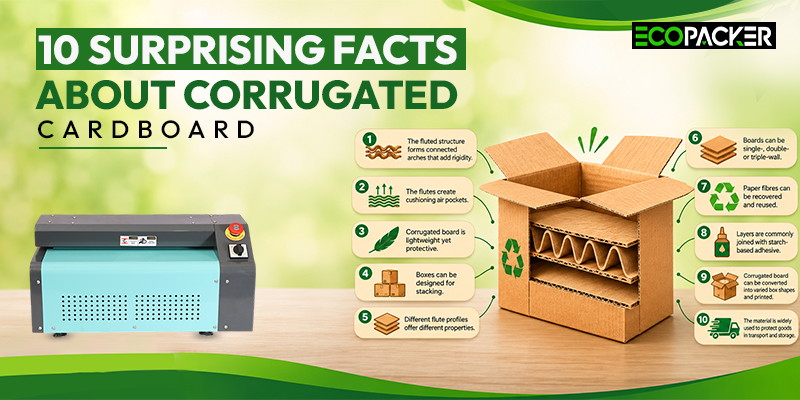
You see corrugated cardboard almost every day, on delivery boxes, shipping cartons and shop displays. Most people treat it as plain brown packaging and throw it away without a second thought. But this simple material has a long history, clever engineering and a strong recycling record. In this post, we share facts about corrugated cardboard that are accurate, easy to understand and useful if you buy, ship or sell products.
You will find the key features, ten surprising facts, a summary of differences with other paper materials, and five quick questions with answers. If you like practical ideas on eco-friendly packaging, you can find more on our blog too.
Key Features of Corrugated Cardboard
- Three-layer build: Two flat liners with a wavy layer in between.
- Light but strong: The wavy layer adds stiffness without adding much weight.
- Cushioning: Air pockets inside the board help absorb bumps and shocks.
- Easy to cut and print: It works for plain shipping boxes and for custom designs.
- Recyclable: Most recycling systems accept clean, dry corrugated board.
- Light to transport: Its low weight keeps shipments lighter than many other materials.
- Many grades: It is made in different thicknesses and strengths for different jobs.
What Is Corrugated Cardboard?
Corrugated cardboard consists of three layers. There are two flat layers known as liners. Between them is a wave like layer known as the fluting (or medium). All three layers are stuck together using glue. The wavy pattern is known as flutes. The hollows within them provide strength and cushioning.
The word cardboard can be used to describe many items, such as thin cereal boxes. In the packaging industry, the 3 layered wavy item is referred to as corrugated board or corrugated fibreboard. Please keep this in mind when reading the facts below.
There are different types of corrugated board available. Single wall board has one wavy layer between the two liners. Double wall board has two wavy layers and three liners. This makes the board very stiff and suitable for heavy items. Triple wall board has three wavy layers and four liners. It is used for very heavy items, such as machine parts and large pallet boxes. The more layers there are the stronger the board will be. However it will also be heavier and thicker.
Surprising Facts About Corrugated Cardboard You Should Know
1. It Is Not Just One Sheet of Paper
Whilst many would see corrugated cardboard as one solid piece of brown paper, it is actually made by gluing 2 flat liner boards together. These are joined to a wavy middle layer. Each part plays an important role. The liner provides resistance to pressure on the surface whilst the middle layer provides separation and rigidity. This means strength is provided by the shape of the board rather than the thickness of the paper.
2. It Was First Made for Hats
The very first patent for corrugated paper was taken out in England in 1856. It wasn’t used for transportation purposes but was instead used as inner lining for tall hats to allow airflow. This idea was developed into packaging in 1871. Albert Jones of New York patented single faced corrugated board to wrap around glass bottles and lamps chimneys. A few years later a flat liner was added on either side and the board we use today within boxes was formed.
3. The Waves Work Like Tiny Arches
If we look at a cross-section of the box we can see a series of small waves. Each of these acts like an arch which is one of the oldest strong shapes used in construction. Arches transfer the weight around the curve of the shape so that it doesn’t put pressure on a single point. The corrugated board has thousands of small arches supporting the weight and the flat liners on each side work together similar to the top and bottom of an I-beam.
4. There Are Several Flute Sizes
Corrugated boards can be manufactured in various flute sizes, most commonly being A, B, C, E and F. A flute is one of the thickest corrugations offering good cushion and stacking. B flute is a thinner, flatter flute providing good resistance to crushing and printing. C flute is a medium flute that is very widely used in shipping cartons. E and F flutes are extremely thin and are often used in retail boxes that require high quality printing. Choosing the correct flute can be one of the easiest ways to boost your box performance.
5. It Is Strongest from Top to Bottom
The strongest direction to apply pressure to corrugated board is along the direction of the flutes. To ensure that the flutes run vertically within the box, the board is cut during box making. If pressure is applied to the side of the flute then the wave will buckle much easier. This can result in the board feeling very strong in one direction but weaker in another direction. This is why it is important to consider the flute direction when stacking boxes onto a pallet.
6. It Is Mostly Air
Much of a corrugated board is made up of air. The flutes are full of trapped air, keeping the board light, providing some impact resistance and reducing thermal conduction. This means that the corrugated box can provide protection against minor impacts and moderate temperature fluctuations without the box being too cumbersome to carry and transport in large quantities.
7. It Is One of the Most Recycled Packaging Materials
Corrugated cardboard is one of the most recycled packaging materials in the world. Industry groups in the United States report that around 90 percent of old corrugated containers have been recovered for recycling in recent years. Used boxes are broken into pulp, cleaned and turned into new paper for new boxes. Many corrugated boxes on the market already contain a high share of recycled fibre.
8. Its Fibres Can Be Reused Several Times
Every time fibre is recycled it gets shorter and weaker. Corrugated fibre will typically only survive 5 to 7 cycles in the recycling loop before being too short to produce strong box material. It can still however be used in weaker paper products. This means that a certain amount of virgin fibre must be added to new board to ensure strength.
9. Humidity Weakens It
The paper will absorb moisture from the atmosphere and any direct contact. The fibres will then become softer making the board lose rigidity. Boxes stored in a humid environment or sitting on a damp floor will be more likely to warp and collapse much quicker than boxes that have been kept dry. This can easily be avoided by storing cartons in a dry location, keeping them off the floor using pallets and not stacking them too high.
10. It Can Live a Second Life
A used box does not have to end its life in the bin. Corrugated cardboard can be shredded into soft cushioning for fragile items, cut into dividers and edge guards, or slit and expanded into a wrap. A cardboard perforation machine does this by turning waste boxes into a honeycomb-pattern cushioning material, which is a practical way to reuse boxes in a home business or a warehouse. People also use it for furniture, school projects and even boats built for cardboard boat races. Of all the facts about corrugated cardboard, this second-life use may be the most useful, because it reduces waste and lowers the need for new packing material.
Where Is Corrugated Cardboard Used?
Corrugated card can be found in the majority of industries. Online stores use it for packaging and mailers. Food and farming industries use it as boxes for produce, pizza boxes and trays. Retailers use it for point of sale displays and printed packaging. Manufacturing uses it as a divider, padding and corner protection. It can be used as moving boxes, storage boxes, craft kits and affordable furniture. Corrugated card is a lightweight, strong material that can easily be printed on and recycled, making it the obvious choice for many products.
Summary of Differences: Corrugated Cardboard vs Other Paper Materials
- Corrugated board vs plain paperboard: Paperboard is a single thin layer, used for cereal and similar boxes. It is lighter but has less crush resistance and almost no cushioning compared with corrugated board.
- Corrugated board vs kraft paper: Kraft paper is a thin, strong sheet used for wrapping, bags and liners. Corrugated board uses kraft paper for its liners but adds a wavy layer for stiffness and cushioning.
- Corrugated board vs honeycomb board: Honeycomb board has six-sided cells and, in many cases, higher compression strength and better cushioning at a similar weight. Corrugated board is more common and easier to turn into everyday boxes.
- Corrugated board vs solid fibreboard: Solid fibreboard is a thick, dense sheet that is heavier and less cushioning. Corrugated board gives good strength for much less weight.
Frequently Asked Questions
Q1. What are the most useful facts about corrugated cardboard for businesses?
It is light, strong along the flutes, widely recyclable and weak when wet, so it should be stored dry.
Q2. Is cardboard the same as corrugated cardboard?
No, cardboard is a general word, while corrugated cardboard always has a wavy layer between two liners.
Q3. Is corrugated cardboard recyclable?
Yes, most recycling systems accept it when it is clean and dry, though greasy or food-soiled pieces are a problem.
Q4. Why does corrugated cardboard have a wavy layer?
The waves act like small arches that add strength and cushioning without adding much weight.
Q5. How can I make cardboard boxes last longer?
Keep them dry, store them off the floor and avoid stacking them too high for a long time.
conclusion
These facts about corrugated cardboard show that a simple brown box is smarter than it looks. It began as a hat liner, gets its strength from tiny arches, works best from top to bottom and loses strength when it gets damp. It is also one of the most recycled packaging materials, and used boards can be shredded, cut or expanded into new packing material. Knowing how it works helps you choose the right board, store it well and reduce waste. To read more packaging guides, visit the Ecopacker blog.
