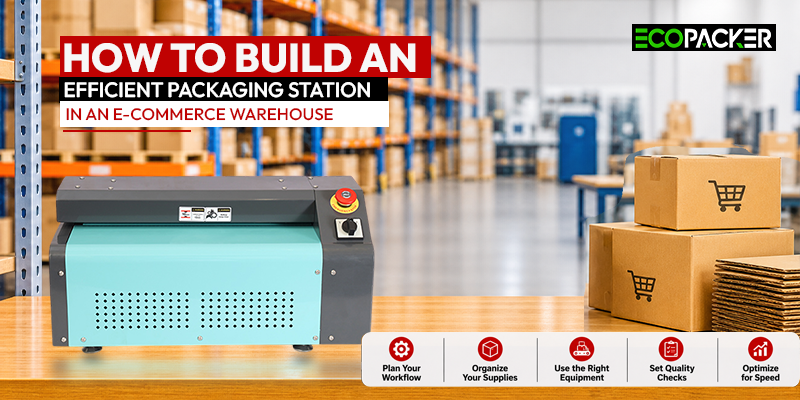
The final stage of any order being delivered online is the packing station. A messy or poorly designed packing station can cause wasted staff time, incorrect orders being sent out and damage to your product. By having a well-designed warehouse Packaging Station, everything is easy to access and simplifies the packing process. This means that your team can easily pack more orders with minimal errors. You’ll learn how to design, create and improve your packing station in this guide. Whether your business is small or a large fulfillment centre.
Key Features of an Efficient Packing Station
Before going into the details, here are the main features that every good packing station should have:
- One-direction workflow: items move from incoming to outgoing without crossing paths.
- Right-height packing table: workers can pack without bending or overreaching.
- Tools within arm’s reach: tape, cutter, labels, and fillers are always close.
- Barcode scanner and label printer: orders are checked and labeled quickly and correctly.
- Weighing scale: the weight of each parcel can be verified before dispatch.
- Bright, even lighting: labels and product details are easy to read.
- Separate bins: one for packed orders, one for empty boxes, and one for waste.
- Clear markings and simple instructions: new workers learn the process fast.
What Is a Warehouse Packaging Station?
The packaging area in your warehouse is where you check, pack, seal and label your picked items to prepare them for shipping. This is between your picking and shipping areas. For a small seller you may only have one table but for a large fulfillment centre, you may have multiple identical packaging stations.
Sometimes you will see ‘packing’ and ‘packaging’. Packing is simply the act of placing your products in a box or mailer, whereas packaging refers to the materials.
Why an Efficient Packing Station Matters
Packaging is an extremely important part of the process. If it takes too long to package items this will cause order delays. If not done carefully items can be shipped incorrectly and then returned. Using large boxes can increase shipping costs as most couriers charge based on volumetric weight. This means that you take the length x width x height and divide it by a set number provided by the courier. If not well packaged items can become damaged causing refunds and negative reviews. If the packer is tired they are more likely to make mistakes meaning comfort has a direct impact on accuracy.
Step 1: Plan Your Space and Workflow
Start with your numbers. Check how many orders you ship each day, what sizes and types of products you sell, and when your busiest seasons are. This tells you how many stations you need and how much space each one requires.
Place the station close to where picked items arrive and close to where parcels are handed over for dispatch. This reduces walking time. Then map the journey of one order from start to finish and remove any step that does not add value. Keep walkways clear so workers and trolleys can move safely.
Step 2: Choose the Right Table and Make It Comfortable
The packing table is the heart of the station. Its surface should be smooth, strong, and large enough to hold the biggest product along with its box. The table height should be close to the worker’s elbow level so they do not have to bend or lift their arms too high. If your team has workers of different heights, adjustable-height tables are a good option.
Since packing is done standing up, anti-fatigue mats can reduce strain on the legs and back. Place the items used most often between waist and shoulder height. This zone is the easiest to reach and the safest for the body.
Step 3: Add the Right Equipment
The equipment you need depends on your volume, but most stations include:
- a barcode scanner to match each item with the order,
- a scale to check parcel weight,
- a label printer for shipping labels and packing slips,
- a tape dispenser and a safe cutter,
- a screen or handheld device to view order details.
Machines That Speed Up Packing
As order volume grows, manual work starts to slow the station down. Machines can take over the repeated tasks:
- Paper bubble machine: it turns paper into cushioning on demand, so workers do not need to store large rolls of bubble wrap alternatives.
- Wrapping machine: it wraps products quickly and evenly, which saves time and gives a neat, secure finish.
- Cardboard shredder: it converts used boxes into filler materineat, secure finish.l, so you can reuse cardboard instead of throwing it away.
Always choose a machine based on your daily order count and product type, not on what looks advanced. A small seller may need only one machine, while a busy fulfillment center may need several.
Step 4: Organize Packing Materials and Use Right-Sized Boxes
Store packing materials where workers can reach them without leaving the station. Keep the most used box sizes at the front, and label each shelf clearly. Do not overstock the station. Keep a small amount at the bench and refill it from a separate supply area.
Always use a box that fits the product. A box that is too large wastes material and raises shipping costs. A box that is too small can crush the product. Fill any empty space inside the box so the item cannot move.
Common options include paper cushioning, air pillows, and foam. Choose based on how fragile the product is and how it will be shipped. You can read a detailed comparison in this guide on paper cushioning vs air pillows vs foam. Poly mailers work well for soft items that are not breakable, such as clothing.
A useful tip: making cushioning on demand saves storage space and keeps the bench clean, because workers produce only what they need for each order.
Step 5: Design the Layout for Smooth Movement
The layout of a warehouse packaging station should follow the natural order of work. A simple flow looks like this: incoming bin, scanning, packing, sealing, labeling, and outgoing bin. Place each item in this order from one side of the table to the other. For right-handed workers, the incoming items usually go on the left, and the finished parcels go to the right.
For small spaces, a U-shaped setup works well because the worker can reach everything without taking steps. For larger operations, a straight line of stations along a conveyor or trolley path keeps things organized.
A helpful method here is the 5S approach: sort out what you need, set everything in a fixed place, keep the area clean, make the rules standard, and sustain the habit. When every tool has a marked place, workers spend less time searching and more time packing.
Step 6: Build in Checks for Accuracy
Speed is useful only when orders are correct. Ask workers to scan each item before packing and compare the order details with the product in hand. Weigh the sealed parcel and compare it with the expected weight. A big difference can show a missing or extra item. Add the packing slip, close the box properly, and attach the label on a flat surface where it can be scanned easily.
Track errors and damage claims every week. If one product keeps getting damaged, improve its packing method instead of blaming the worker.
Step 7: Focus on Safety and Waste Management
A safe station will be a quick station. You should ensure you are using safety cutting tools, have no torn tape and loose paper on the floor and workers are lifting heavy items properly. Fire exits and passageways can be kept clear.
Separate bins for your card, paper and plastic waste can help you recycle easily. Try to reuse clean cartons for fillers. By training your staff you can reduce waste by implementing these small changes.
Common Mistakes to Avoid
- Placing the station far from picking and dispatch areas
- Using tables that are too high or too low
- Keeping too many materials at the bench
- Skipping scan or weight checks to save time
- Using one box size for every product
- Ignoring worker feedback about comfort and flow
Differences: Basic vs Efficient Warehouse Packaging Station
| Feature | Basic Station | Efficient Station |
| Layout | No fixed flow, items move back and forth | Clear one-direction flow |
| Table | Random table, wrong height | Right height, suitable size |
| Tools | Scattered and often missing | Fixed place, within arm’s reach |
| Materials | Piled up or stored far away | Organized by size and use |
| Accuracy | Visual check only | Scanning and weight checks |
| Speed | Slow, with frequent delays | Steady and predictable |
| Waste | Mixed bins, extra filler | Separate bins, right-sized boxes |
| Worker comfort | Strain and early tiredness | Better posture and less fatigue |
In short, the main difference is planning. An efficient station is not about costly machines. It is about a clear process, the right tools, and a comfortable setup.
Conclusion
Building a good packing area does not need a big budget or a complicated plan. Start by studying your order volume, then set up a comfortable table, place tools and materials within easy reach, and follow a simple one-direction flow. Add scanning and weight checks to protect accuracy, and focus on safety and waste control. A well-organized warehouse packaging station saves time, reduces damage and returns, and helps your business deliver a better experience to every customer. Review your setup regularly, listen to your team, and keep improving it as your business grows.If you are searching for dependable and eco-friendly packing equipment to set up your workspace, EcoPacker is a trusted name worth exploring. Their range of paper cushioning and wrapping solutions can help e-commerce sellers pack faster, protect products better, and reduce plastic use.
Frequently Asked Questions
Q1. How much space does a warehouse packaging station need?
It needs enough room for the table, supplies, and bins, plus space to move freely, which depends on your product size and order volume.
Q2. What is the best layout for a packing station?
A straight-line or U-shaped layout where items move in one direction from incoming to outgoing works best.
Q3. How can I reduce packing time?
Keep tools within reach, use barcode scanning, and arrange materials by size and frequency of use.
Q4. What equipment is must-have at a packing station?
A sturdy table, scanner, scale, label printer, tape dispenser, and suitable packing materials are the basics.
Q5. How can I reduce packaging waste?
Use right-sized boxes, reuse clean cardboard as filler, and choose recyclable packing materials.
Eco-Friendly Packaging
Interested in the Eco-Packer Machine?
Fill out our inquiry form and our team will get back to you within 24 hours.
