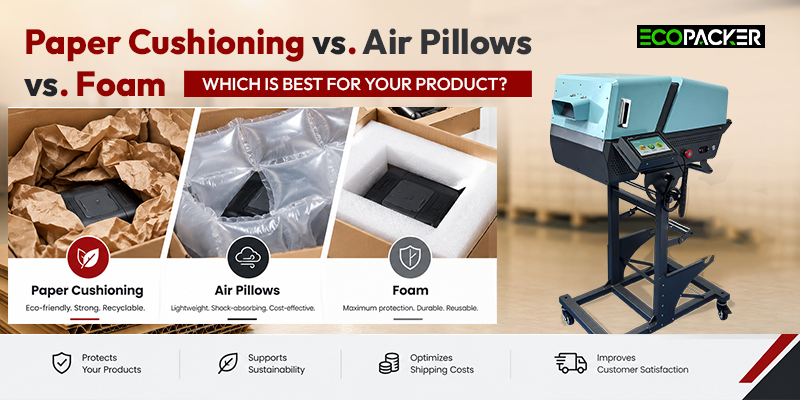
Every package faces drops, bumps, vibration, and pressure on its way to the customer. What you put in the box determines if a product will arrive undamaged at the hands of the buyer. The most common materials are paper cushioning, air pillows, and foam. They all are significantly different in the way of protection that they provide and none of them is universal, meaning that there is always a more suitable option for a particular product. This paragraph aims to introduce you to the materials for cushioning products in a box and highlight their advantages and disadvantages. In addition, you will get to know the basic principles of operation of void fill packaging materials.
Key Features at a Glance
- Paper-based fill: Made from kraft paper, recyclable, good for void fill and blocking, and compact to store as rolls.
- Air pillows: Plastic film filled with air, very light, stored flat until inflated, and ideal for light items.
- Foam: Polyethylene (PE), polyurethane (PU), or expanded polystyrene (EPS). It gives the strongest shock and vibration protection and can be cut to fit a product.
- The right choice depends on product weight, fragility, shipping distance, storage space, and sustainability goals.
Why the Right Cushioning Matters
A damaged package may create high costs due to the returned products and the need to organize a new shipment. In addition, such a situation may lead to customer complaints. The most common reasons for damage are impact (usually as a result of drops), vibration (caused by uneven road surfaces), and compression (as a result of stacking). The most effective way to prevent damage is to ensure that the product will not move inside the packaging. This can be achieved by proper cushioning that will absorb the blow in case of drops, the lack of movement of the product due to vibrations, and the absence of pressure due to stacking. Such a situation is particularly dangerous when the packaging is made of a softer material, but the product inside moves, albeit slightly.
What Are Void Fill Packaging Materials?
Void fill packaging materials are items that are put in a vacant space in a box. There are three types of functions that void fillers perform. The first is to hold the product in place and prevent it from sliding. Second, they provide cushioning that protects the product from impacts. Third, they provide blocking which holds heavy items in place. Some void fillers offer multiple functions while others offer only one function.
According to many packing guidelines, 5 centimeters (2 inches) of protective materials should surround fragile products around all sides. Whatever material is selected, the cardboard should still be heavy duty since cushioning is not a substitute for reinforced cardboard.
What Is Paper Cushioning?
It is made from kraft paper that has been crumpled, folded or formed into hexagons. Many manufacturers will produce this type of filler from rolls of paper as needed, eliminating any need for bulk storage of the finished product.
The primary advantage of this filler is that it is recyclable, being made of paper that can be returned to the recycling chain with cardboard packaging. Can be used both as a void filler and for wrapping fragile items such as glass jars, ceramics and decorative items. The rolls are relatively compact to store and create little static or dust.
However, the disadvantages of this filler are also considerable: compared to foam, it provides inferior protection at a given thickness, has greater specific gravity compared to air-filled packaging and loses strength when wet. Additional layers may be required to achieve the necessary level of protection, when packing heavy or delicate items.
Air Pillows: Light and Fast
Air pillows are made of plastic film and placed in a bag as a flat roll that is inflated when required. Bags are the lightest of all, thereby reducing the overall weight.
They are ideal for packing small and medium-sized items such as books, clothes, cosmetics, and other personal accessories. The only disadvantage is that they are vulnerable to punctures and can be easily lost during inflation, which rules out their application in packing sharp and heavy items.
One should pack fragile items wrapped in air pillows, preferably placed among other packed items. Note that depending on the location, the plastic film used can be subject to recycling, so it is critical to conduct research on the prevailing recycling policies in the chosen location to dispose of them appropriately.
Foam: Strong Protection for Delicate Goods
Foam, also called polyethylene (PE), polyurethane (PU), or expanded polystyrene (EPS, EPS also known as thermocol). Foam is a good damper for impact. In addition, it is easily cut or moulded to shape and therefore, it is a preferred material for packing electronics, instruments, and precision parts. It also provides protection to the surface from being abraded. On the contrary, it requires substantial storage space, especially for pre-formed foam, and time and effort are needed to develop customized foam inserts. Furthermore, most foams are not recyclable. So, foam is a high-performance material, but it may not be an optimal solution in terms of sustainability and space.
Air Pillow vs Foam Packaging: A Direct Comparison
In comparing air pillows vs. foam, the dilemma is always between the degree of protection and convenience. In terms of superior protection, reduced vibration, and a perfect fit, foam certainly wins. However, in terms of reduced weight, storage convenience, and speed, air pillows are better.
If the product being shipped is somewhat expensive, fragile, sensitive to vibrations, the choice of packaging material leans more towards foam. If the product being shipped is light, not fragile, and only needs the box to fulfill its destination, air pillows are a better choice. Most shippers use a combination of the two, using foam to fill the corners of a box and air pillows to fill the spaces that foam cannot reach.
Best Cushioning Material for Shipping, by Product Type
The materials for packing the items safely during transit mostly rely on the contents of the box, which is why it is important to take into account such details while picking the best options. For instance, for packing electronics, it is recommended to use foam inserts or corner pieces or to use anti-static material, if needed. Glassware, ceramic items, and décor need to be individually wrapped and then placed on the box with paper or foam cushioning to ensure that objects are not in direct contact with the box.
Cosmetics, jars, and similar objects can safely be placed in the box after wrapping them and using paper fill or air pillows in order to hold apart such things thus avoiding potential collisions. The most appropriate method as far as packing books, garments, and other light accessories is concerned is to go for air pillows or void fill paper. Heavy items require more protection, so it is advisable to use thick foam or cardboard blocking in combination with a robust box. Regardless of the items and the materials used for packing, it is essential to do a drop test for quality control. For this sake, one would need to drop the box at waist height on each of the sides in order to check if items are not damaged during transit.
Weight, Storage, and the Environment
The shipping cost is determined by the weight and the box size; therefore, it is essential to minimize the former and choose the latter appropriately. Air pillows are the lightest of all, then comes the paper, and the foam varies depending on the type. As for the storage, air film and paper rolls save the most space, while the ready foam rolls, on the contrary, take the largest volume. In terms of the environmental friendliness, paper is the most suitable option, as it can be recycled relatively easily. Foam is the hardest one to recycle, while air pillows depend on the local availability of film recycling. The worldwide trend is moving towards reducing the usage of plastic, especially in such industries as food packaging, cosmetics, pharmaceuticals, and retail. Many nations have developed their policies concerning the management of plastic waste, and some countries, such as India, have banned it completely; thus, a company should consider this factor when choosing packaging materials.
Summary of Differences
| Feature | Paper | Air Pillows | Foam |
| Shock protection | Medium to good | Low to medium | High |
| Vibration control | Medium | Low | High |
| Weight | Medium | Very light | Light to medium |
| Storage space | Low (rolls) | Very low (flat film) | High (pre-formed) |
| Recyclability | Easy | Limited, depends on local collection | Difficult |
| Best use | Void fill, wrapping, blocking | Light items, void fill | Fragile, high-value, vibration-sensitive items |
| Main weakness | Weak when wet | Leaks if punctured | Bulky and hard to recycle |
These ratings are general. Real performance depends on thickness, density, and how well the item is packed.
How to Choose the Right Option
Begin with the product’s weight, delicacy, and size. Next, calculate the distance and method of transportation. Then, determine the number of pieces that can be stored and the speed of packing. Finally, take into account the brand’s expectations and legal requirements in the region.
Many companies use a combination of materials for packaging, such as foam for high-end products and paper or air pillows for standard orders. In addition, it is important to test a new material with a trial shipment and not make changes to the entire system at once.
Conclusion
There is no single winner. Foam gives the strongest protection, air pillows are light and quick, and paper cushioning is a recyclable all-rounder for many everyday products. Match the material to the product, test it, and keep the box strong and right-sized. A little planning reduces damage, returns, and waste.
If you are looking for a reliable partner to make this switch easier, Ecopacker offers eco-friendly packaging machines, including paper cushion machines, shredders, and wrapping machines, that help businesses create protective packaging on demand.
Frequently Asked Questions
1. Which is the best cushioning material for shipping?
There is no single best; foam suits delicate items, air pillows suit light items, and paper suits general void fill.
2. Is paper cushioning as strong as foam?
Not at the same thickness, but with enough layers it protects many products well.
3. Are air pillows good for fragile items?
Only as a second layer after wrapping the item, because a puncture removes the protection.
4. What are void fill packaging materials?
They are materials like paper, air pillows, and packing peanuts that fill empty space so the product cannot move.
5. Which option is the most eco-friendly?
Paper is usually the easiest to recycle, foam is the hardest, and air pillows depend on local plastic film recycling.
Eco-Friendly Packaging
Interested in the Eco-Packer Machine?
Fill out our inquiry form and our team will get back to you within 24 hours.
